
Balanced Immunity
Growing up with two older sisters was an incredible experience. It was incredible having not one, but two, older sisters around every day to teach me things, protect me from dangers, and genuinely care for me. I wouldn't be who I am today without their support, wisdom, and shared laughter.
On another note, it was also incredible what these two got away with when my parents weren’t around. They would dress me up in their clothes, paint my face with their makeup, make me fetch things for them, and they were always coming up with hysterical practical jokes with guess who as the mark. Funny how those closest to you – the people who would do anything to protect you – are the ones who can also get your goat the most.
If you ask them today about all this, they might offer a subtle dismissal, citing the fact that I’m “the sensitive type.” They wouldn’t be wrong. When I was young, life often felt hard. I used to cry when my sandwiches fell apart. It would start out okay, but after a few bites, the meat would slip through and hit my plate with a thud, and I’d be crushed. My whole family knew it was coming too. The whole thing was a big scene at the dinner table.
Fortunately, things have changed. With the advent of tortilla wraps, I no longer struggle with unreliable sandwiches. Also, through my sisters’ unyielding program of character development, I learned to tolerate distress pretty well. What doesn’t kill you, makes you stronger, right? How does this relate to the brain? Let's discuss...
So far, we have discussed how neurons mediate our experiences in life. In that frame, we can envision the brain as a big, tangled network of interconnected neurons. But neurons are not alone in the brain. In between, and all around, the neurons sit glial cells. Glial cells perform many thankless jobs. They feed neurons nutrients. They help neurons stay in place. They keep the area around neurons clean. And, as discussed in chapter seven, they produce myelin to enhance the efficiency of communication in the brain.
Glial cells are like the mortar between all the bricks in a wall. The bricks in a wall are what catch our eye. However, it’s the mortar, which tends to fade into the background, that is keeping the wall upright. Without the mortar holding the wall together there would just be a cluttered pile of bricks. Although glial cells don’t get as much attention as neurons, they’re necessary for keeping everything together and functional in the brain.
Microglia are a specific type of glial cell. Their primary job is to protect the neurons. You might not think that neurons are in much danger deep beneath the skull. But the brain is essential to our survival. Just in case, nature invented these watchmen. Not only are microglia important, they are also numerous. Interestingly, in some brain areas, microglia outnumber neurons.195 As a rule, nature tends to be very conservative with its resources. The body cannot afford to be frivolous with it’s energy and resources. It wouldn’t expend energy and resources on creating and maintaining certain brain cells if it was not worth it. Microglia are definitely worth it. To be sure, if microglia outnumber neurons, then that gives you an idea of how important they are to our health.
What exactly do microglia do? Again, microglia are not used for communication. Instead, they are there to protect the brain from infections, toxins, and other insults.196–198 Here’s how it works: Microglia reside in the in-between spaces in the brain’s interwoven network of neurons. They lie in wait, ready to jump into action when the brain is challenged by a toxin, dying cell, or infection.
Before being summoned, microglia stay relatively dormant. Certain toxins and microbes (bacteria and viruses) can find their way into the brain. Once inside the brain, invaders can multiply and try to use up the local resources or block normal metabolic function, eventually damaging neurons. Our loyal and dutiful microglia quickly sense the invasion and spring into action. In defense of the neurons, microglia have a few weapons at their disposal.
When problems arise, microglia become “activated.” First, they start spewing out chemicals. Microglia spray out inflammatory messengers called cytokines in the brain in an attempt to kill microbial invaders. The cytokines signal for other immune cells to migrate over and help. These inflammatory messengers marshal a greater response from other nearby immune cells. This immune response swiftly enters the area and gobbles up the invaders. In addition, microglia can turn into Pacman-like globs themselves and eat up toxic substances in the area.196
So microglia can directly attack, swallow up, can call over reinforcements in defense of neurons. With this elaborate defense, most foreign invaders don’t stand a chance. The flip side is that because this immune system in the brain is powerful, it can potentially harm the same neurons it’s there to protect. Excessive immune responses can occur. Ie excessive or too long lasting, the immune response can irritate, or even damage, brain tissues. This inadvertent damage to the brain can then alter our mental and emotional experience.
Fried Nerves
The problem with the immune system in the brain is that sometimes the defense of self is too aggressive. Sometime the defense is overdone. Microglia can be equally destructive as they can be protective. Sometimes their defense of self is overdone.
Before an infectious bug or toxic invader can get to the neurons, microglia step in to disarm and neutralize these threats. Then neurons can proceed as normal, blissfully unaware. Microglia take their job seriously. Unfortunately, sometimes too seriously. Just like my sisters, microglia make sure that no outsider ever comes enters the brain and messes with the neurons. If anyone is going to screw with the neurons, it’s the microglia.
Microglia are here to protect us. If the defense is balanced, the microglia work to keep the brain clean by attacking the right targets, at the right time, in the right places, to the right degree. If our immune system is balanced, microglia are able to sense when the threat has passed. With help from those signals from the body that things are okay, microglia turn off. At that point, they are no longer activated.
In the face of some toxin or infection, activated microglia are there to help us. However, in the context of chronic inflammation or persistent environmental toxin exposure, microglia remain activated. In these situations, microglia forget to turn off. Activated microglia continue to spew out cytokines. With no real enemy to attack, activated microglia can turn their weaponry on nearby healthy neurons, which may eventually destroy them.199 These neurons are innocent bystanders in an unnecessary war.
Many of the stress-inducing factors of modern-day life foster chronic inflammation and promote this kind of pointless warfare. Once neurons are destroyed in an immune battle, normal brain function is interrupted. Again, when microglia are chronically activated, neurons can be overstimulated or even destroyed.
So with any kind of physical illness, or immune imbalance in the body that leads to excess chronic inflammation, there’s an ever-present danger in too many microglia being unnecessarily activated, or certain microglia staying activated for too long.200 If the protective response of microglia is too aggressive, further brain inflammation and neuronal destruction will ensue. Then our mental wellness takes a hit.
It’s the excessive exposure to the toxic environmental stressors of modern-day life triggers our immune system to overreact. Examples of these modern-day toxins and stressors include diets full of processed foods and sugar, lack of movement and exercise, poor quality air and water, exposure to industrial toxins and pollutants, and even mental and emotional stress. All of these environmental factors can lead our microglia to become chronically and unnecessarily over-activated.200 Modern-day life is the villain in this story. It’s always lurking in the background. It stalks us, day and night. Nevertheless, with awareness and the right plan, we can be the heroes in our story.
The most important thing to remember is this: when there’s excessive inflammation in the brain, it can lead to excessive neuronal excitation. Excessive excitation can lead to depression and other forms of mental illness.201 When our neurons are overstimulated, we become vulnerable to mental health symptoms.6,83–85,202
An inflamed brain can lead us to feel distracted, unmotivated, foggy, irritable, and like we want to recede inward. While inflammation isn’t typically the one and only cause of mental illness for an individual, inflammation can contribute to depressive and anxious symptoms.6,83–85,202 In some cases, it can lead to more severe mental illness, such as schizophrenia.203 In the mildest form, inflammation may just make you want to stay home, lay in bed for hours, and avoid socializing with the people you actually do enjoy spending time with. Being of two minds like that can be a head scratcher. But, does it sound familiar to you?
A Thanksgiving to Remember
Here’s something to remember: inflammation begets more inflammation. Inflammation can overstimulate neurons. Eventually, that overstimulation can destroy those neurons. Once they die, cell fragments yard sale all over neighboring neurons. That mess has to be cleaned up. In the best-case scenario, microglia are called into action. They swiftly deal with the mess and then are supposed to retreat back into dormant mode. Microglia need to turn off for the inflammatory response to cease.
With those ever-present toxic environmental stressors, the body’s inflammatory response keeps humming. If the inflammatory response doesn’t stop, then excessive and unnecessary immune responses will create further harm in the brain. Once you start out down the path of toxicity, oxidative stress, and inflammation, our immune system takes over and it can become a runaway train from there.
It’s like that one Thanksgiving dinner where all it took was just that one comment from Auntie. She clearly felt justified in stating the obvious. Certain family members took offense. The next thing you know, everyone in the family starts chiming in, bringing up old stuff, taking it to a whole other level. A little flame turned into a house fire.
The job of the microglia is to clean up the mess and protect the brain. It’s a necessary and important job. But there’s a delicate balance that needs to be struck. Once brain cells die, or become damaged, they spill their guts all over the place. This gives the microglia and other immune cells in the brain another reason to stay active. We need microglia to become activated to clean up that mess. But, we also need those activated to deactivate once the job is done. Activated microglia, if unchecked, persist past the point of being helpful. They can actually worsen the problem by killing more and more innocent neighboring brain cells by spewing out their inflammatory cytokines.199–200
This is like the other highlight of Thanksgiving when grandma offers to help do the dishes, but then ends up pulling out all your dishes and glassware in order to reorganize them in a way that “makes way more sense.” What starts out intending to be helpful, can end up being less so.
Unfortunately, Modern-day life is toxic & inflammatory. Toxins like heavy metals, pesticides, and other environmental pollutants directly harm our neurons. In addition, toxins can trigger an inflammatory response in our brain. Inflammation overstimulates our brain, leading to further damage. Any neuron that gets overstimulated has the potential to give up and die. This overstimulation leading to neuronal cell death is called excitotoxicity.204 All of these insults contribute to mental illness symptoms.
What’s worse is how all of this destruction plays out over the long run. The death of these brain cells can contribute to neurodegenerative diseases like Alzheimer’s and Parkinson’s Disease. The cascade of neuronal death continues until some other anti-inflammatory influence steps in and turns off the activated microglia.205
Who Wants Pie?
As mentioned, microglia step in when something seems off with a neuron. It may have been damaged by a toxin or infection. It may have been overstimulated to the point of exhaustion and then it decides to give up and die. When something’s off with neurons, microglia get to work. They either eat up the dead and dying cell parts, or they marshal other immune cells to the area by churning out inflammatory cytokines. When microglia send out their cytokines, they are fighting fire with fire. Sometimes all that aggressive action creates more of a mess.204
Fortunately, many of the nutrients highlighted in TMWD can help to tame overactive microglia. Plant foods actually play a bigger role here. Flavonoids are key nutrients that can help quell inflammation and activated microglia. When it comes to family conflicts, it usually takes one of the elders to step in and tell everyone to knock it off. Flavonoids and other key nutrients play this role. They quiet everything down by turning off activated microglia.
Flavonoids are a subcategory of polyphenols. Curcumin from turmeric, resveratrol from grapes, and EGCG from green tea are some polyphenols whose name you might recognize. In addition to these three, there are a number of other flavonoids with funny sounding names. All can help combat inflammation in the brain.
Flavonoids arrive on the scene and they try to mop up some of the chaos. If microglia are the foot soldiers, then flavonoids are the secret service members in the brain and body. Flavonoids offer aid to neurons by acting as antioxidants. 206 Antioxidants are the heroes of the brain that jump in front of oxidative stress bullets. By taming oxidative stress, flavonoids provide another form of protection to neurons.
Flavonoids are actually the pigments in many colorful plant foods. Once they get into the brain, they provide that anti-inflammatory signal that can rebalance the immune system in the brain. Flavonoids step in to protect innocent cells from being harmed by activated microglia.207
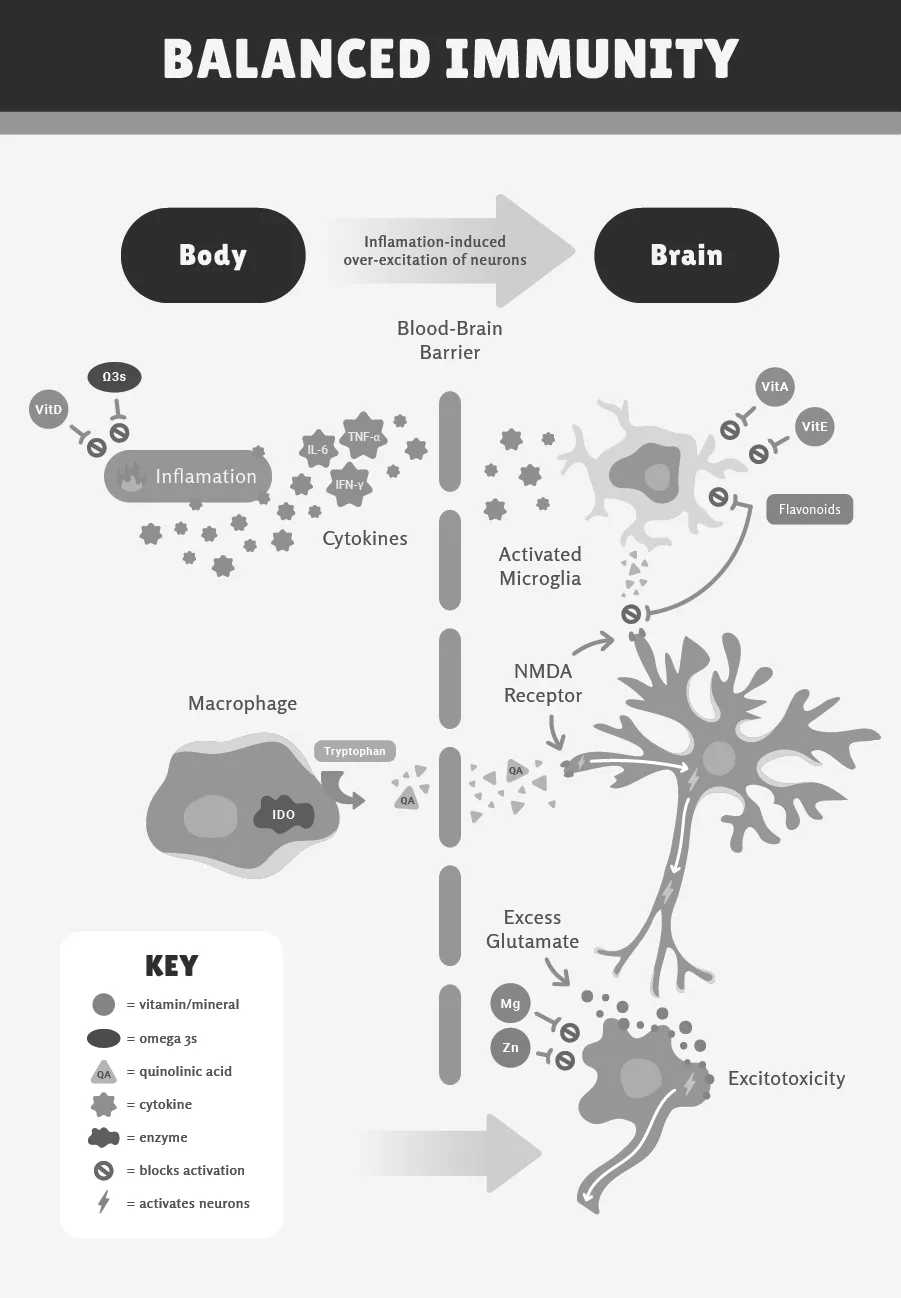
- Vitamin D and Omega 3 fatty acids are critical for preventing inflammation in the body from getting out of control, which helps keep the brain’s immune system in balance.
- Cytokines (Il-6, TNF-alpha, IFN-gamma, among others) are the inflammatory messengers that can activate microglia in the body and overstimulate excitatory neurons in the brain.
- Quinolinic Acid is a byproduct of inflammation in the body that can also overstimulate excitatory neurons.
- Inside Macrophages, an enzyme called Indoleamine 2,3-dioxygenase (IDO) steals tryptophan and converts it into Quinolinic Acid, which then crosses into the brain.
- Vitamin A, Vitamin E, and Flavonoids are nutrients that can quell activated microglia, reducing the inflammatory (and excitatory) burden in the brain.
- Magnesium and Zinc are protective against inflammation induced overstimulation of excitatory neurons
To summarize, flavonoids calm the immune response in the brain by acting as antioxidants206, and stunting the flow of excessive inflammatory cytokines from the activated microglia.208 Even more impressive, flavonoids act as signaling molecules that turn off activated microglia, returning microglia to their dormant, non-destructive state in times of health.209–211 In times of need, flavonoids can step in and initiate the deactivation of microglia. In this way, they prevent neurons from being overstimulated.208
Beyond flavonoids, there are some additional nutrients that help balance the immune response in the brain. Vitamin A212 & Vitamin E213–214 can also dampen the release of cytokines from activated microglia. Omega-3s215–216 and Vitamin D217–218 put a check on overactive inflammatory response all over the body. That’s important, as inflammation originating in the body somewhere can easily activate dormant microglia in the brain. Further, several minerals act as safeguards against the overstimulation of neurons. Namely, magnesium and zinc snuggle into excitatory neuronal receptors, making it harder for those neurons to fire.
Flavonoids, the fat-soluble vitamins (A, D, & E), as well as the Omega 3 fatty acids, are all great nutrients to have on board as we face a highly inflammatory and toxic world. Maybe next Thanksgiving sneak some extra flavonoid-rich spices into the pumpkin pie, then see how Auntie reacts. If problems persist, try to up the dose.
Immune Balancing Nutrients
| Mineral | Function | Food Sources |
|---|---|---|
| Magnesium | Protects against overstimulation of excitatory neurons | pumpkin seeds, almonds, peanuts, sunflower seeds, lima beans, plantains, potatoes, black-eyed peas, apricots, edamame, acorn squash, mussels, shrimp, clams, oysters, summer squash, tomatoes, milk, cheese, blackberries, arugula, dark chocolate (70% or greater) |
| Zinc | Protects against overstimulation of excitatory neurons | oysters, beef, pumpkin seeds, lobster, lamb, pasilla peppers, edamame, garlic, chickpeas, black-eyed peas, pinto beans, broccoli raab, mushrooms, fish, dark chocolate |
| Copper | Supports enzyme that breaks down dopamine into norepinephrine; | oysters, sunflower seeds, dark chocolate, almonds, apricots, crab, octopus, lobster, tuna |
| Selenium | Improves function of dopamine receptors | sunflower seeds, oysters, pumpkin seeds, halibut, swordfish, tuna, lobster, fish roe, fish, pork, chicken, turkey, brazil nuts = 544mcg per ounce |
| Vitamin | Function | Food Sources |
|---|---|---|
| Vitamin A | Calms activated microglia | liver, sweet potatoes, carrots, cantaloupe, red peppers, mangoes, black-eyed peas, apricots, cheese, eggs, salmon |
| Vitamin D | Anti-inflammatory | salmon, swordfish, trout, mackerel, herring, mushrooms, cheese, milk |
| Vitamin E | Calms activated microglia | cheese (pastured/grass-fed), eggs (yolks), pork, oysters, dark chicken, liver |
| Nutrient | Function | Food Sources |
|---|---|---|
| Omega 3’s (DHA) | Anti-inflammatory | fish roe, mackerel, salmon, swordfish, oyster, tuna, sardines |
| Flavonoids | Food Sources |
|---|---|
| Anthocyanidins | |
| Cyanidin | raspberries, strawberries, blueberries, blackberries, red cabbage, grapes |
| Flavon-3-ols | |
| Catechins | dark chocolate, green tea, white tea, fava beans, raisins, blueberries, cranberries |
| Proanthocyanidins | apples, berries, red grapes, red wine, chocolate |
| Flavonols | |
| Rutin | buckwheat, rooibos tea, figs |
| Quercetin | red onions, kale, scallions, watercress, apples, berries |
| Flavones | |
| Apigenin | parsley, celery, peppermint, thyme |
| Luteolin | thyme, parsley, peppermint, serrano peppers, celery, chamomile tea, rosemary |
| Flavonones | |
| Naringenin | orange, lemon, lime, tangerine, grapefruit |
| Polyphenols | |
| Curcumin | turmeric |
| Resveratrol | red wine, dark chocolate, grapes, peanuts |
Sources cited in this chapter
Numbers match the superscripts above and the book's full reference list.
- 4.Kelly, J., Kennedy, P., Cryan, J., Dinan, T., Clarke, G., Hyland, N. (2015). Breaking Down the Barriers: The Gut Microbiome, Intestinal Permeability and Stress-related Psychiatric Disorders Frontiers in Cellular Neuroscience 9(2), 215. Find it: reference 4 on Google Scholar
- 6.Raison, C., Capuron, L., Miller, A. (2006). Cytokinessingtheblues:inflammation and the pathogenesis of depression Trends in Immunology 27(1), 24 - 31. Find it: reference 6 on Google Scholar
- 7.Berk, M., Williams, L., Jacka, F., O’Neil, A., Pasco, J., Moylan, S., Allen, N., Stuart, A., Hayley, A., Byrne, M., Maes, M. (2013). So depression is an inflammatory disease, but where does the inflammation come from? BMC medicine 11(1), 200. Find it: reference 7 on Google Scholar
- 8.Vogelzangs, N., Beekman, A., Jonge, P., Penninx, B. (2013). Anxietydisorders and inflammation in a large adult cohort Translational psychiatry 3(4), e249 - e249. Find it: reference 8 on Google Scholar
- 20.Meléndez-Hevia, E., Paz-Lugo, P., Cornish-Bowden, A., Cárdenas, M. (2009). A weak link in metabolism: the metabolic capacity for glycine biosynthesis does not satisfy the need for collagen synthesis Journal of Biosciences 34(6), 853 - 872. Find it: reference 20 on Google Scholar
- 83.Cherbuin, N., Anstey, K., Baune, B. (2017). Oxidative stress, inflammation and mild cognitive impairment European Psychiatry 41(), S742. Find it: reference 83 on Google Scholar
- 84.Jackson M. Evaluating the Role of Hans Selye in the Modern History of Stress. In: Cantor D, Ramsden E, editors. Stress, Shock, and Adaptation in the Twentieth Century. Rochester (NY): University of Rochester Press; 2014 Feb. Chapter 1. Find it: reference 84 on Google Scholar
- 85.Boonstra, R. (2013). Reality as the leading cause of stress: rethinking the impact of chronic stress in nature Functional Ecology 27(1), 11 - 23. Find it: reference 85 on Google Scholar
- 195.Herculano-Houzel, S., Lent, R. (2005). Isotropic Fractionator: A Simple, Rapid Method for the Quantification of Total Cell and Neuron Numbers in the Brain The Journal of Neuroscience 25(10), 2518-2521. Find it: reference 195 on Google Scholar
- 196.Gehrmann, J., Matsumoto, Y., Kreutzberg, G. (1995). Microglia: Intrinsic immuneffector cell of the brain Brain Research Reviews 20(3), 269-287. Find it: reference 196 on Google Scholar
- 197.Block, M., Zecca, L., Hong, J. (2007). Microglia-mediated neurotoxicity: uncovering the molecular mechanisms Nature Reviews Neuroscience 8(1), 57-69. Find it: reference 197 on Google Scholar
- 198.Aloisi, F. (2001). Immune function of microglia Glia 36(2), 165-179. Find it: reference 198 on Google Scholar
- 199.Tay, T., Béchade, C., D'Andrea, I., St-Pierre, M., Henry, M., Roumier, A., Tremblay, M. (2017). Microglia Gone Rogue: Impacts on Psychiatric Disorders across the Lifespan. Frontiers in Molecular Neuroscience 10(), 421. Find it: reference 199 on Google Scholar
- 200.Calcia, M., Bonsall, D., Bloomfield, P., Selvaraj, S., Barichello, T., Howes, O. (2016). Stress and neuroinflammation: a systematic review of the effects of stress on microglia and the implications for mental illness Psychopharmacology 233(9), 1637 - 1650. Find it: reference 200 on Google Scholar
- 201.Patel, A. (2013). Review: the role of inflammation in depression. Psychiatria Danubina 25 Suppl 2(), S216-23. Find it: reference 201 on Google Scholar
- 202.Ates-Alagoz, Z., Adejare, A. (2013). NMDA Receptor Antagonists for Treatment of Depression Pharmaceuticals 6(4), 480-499. Find it: reference 202 on Google Scholar
- 203.Girgis, R., Kumar, S., Brown, A. (2014). The Cytokine Model of Schizophrenia: Emerging Therapeutic Strategies Biological Psychiatry 75(4), 292-299. Find it: reference 203 on Google Scholar
- 205.Saijo, K., Crotti, A., Glass, C. (2013). Regulation of microglia activation and deactivation by nuclear receptors Glia 61(1), 104-111. Find it: reference 205 on Google Scholar
- 208.Leyva-López, N., Gutierrez-Grijalva, E., Ambriz-Perez, D., Heredia, J. (2016). Flavonoids as Cytokine Modulators: A Possible Therapy for Inflammation-Related Diseases International Journal of Molecular Sciences 17(6). Find it: reference 208 on Google Scholar
- 209.Jang, S., reviews, R., (2010). Can consuming flavonoids restore old microglia to their youthful state? academic.oup.com Find it: reference 209 on Google Scholar
- 210.Kim, S. (2015). Inhibition of microglial activation and induction of neurotrophic factors by flavonoids: a potential therapeutic strategy against Parkinson's disease Neural Regeneration Research 10(3), 363-364. Find it: reference 210 on Google Scholar
- 211.Spagnuolo, C., Moccia, S., Russo, G. (2018). Anti-inflammatory effects of flavonoids in neurodegenerative disorders European Journal of Medicinal Chemistry 153(Expert Rev. Mol. Diagn 13 8 2013), 105-115. Find it: reference 211 on Google Scholar
- 212.Oliveira, L., Teixeira, F., Sato, M. (2018). Impact of Retinoic Acid on Immune Cells and Inflammatory Diseases Mediators of Inflammation 2018(), 3067126. Find it: reference 212 on Google Scholar
- 213.Barger, S., Goodwin, M., Porter, M., Beggs, M. (2007). Glutamate release from activated microglia requires the oxidative burst and lipid peroxidation Journal of Neurochemistry 101(5), 1205-1213. Find it: reference 213 on Google Scholar
- 214.Li, Y., Liu, L., Barger, S., Mrak, R., Griffin, W. (2001). Vitamin E suppression of microglial activation is neuroprotective Journal of Neuroscience Research 66(2), 163-170. Find it: reference 214 on Google Scholar
- 215.Mildenberger, J., Johansson, I., Sergin, I., Kjøbli, E., Damås, J., Razani, B., Flo, T., Bjørkøy, G. (2017). N-3 PUFAs induce inflammatory tolerance by formation of KEAP1-containing SQSTM1/p62-bodies and activation of NFE2L2 Autophagy 13(10), 00-00. Find it: reference 215 on Google Scholar
- 216.Layé, S., Nadjar, A., Joffre, C., Bazinet, R. (2018). Anti-Inflammatory Effects of Omega-3 Fatty Acids in the Brain: Physiological Mechanisms and Relevance to Pharmacology Pharmacological Reviews 70(1), 12-38. Find it: reference 216 on Google Scholar
- 217.Djukic, M., Onken, M., Schütze, S., Redlich, S., Götz, A., Hanisch, U., Bertsch, T., Ribes, S., Hanenberg, A., Schneider, S., Bollheimer, C., Sieber, C., Nau, R. (2014). Vitamin D Deficiency Reduces the Immune Response, Phagocytosis Rate, and Intracellular Killing Rate of Microglial Cells Infection and Immunity 82(6), 2585- 2594. Find it: reference 217 on Google Scholar
- 218.Boontanrart, M., Hall, S., Spanier, J., Hayes, C., Olson, J. (2016). Vitamin D3 alters microglia immune activation by an IL-10 dependent SOCS3 mechanism Journal of Neuroimmunology 292(), 126-136. Find it: reference 218 on Google Scholar
From The Mental Wellness Diet: Ancient Wisdom - Evolving Science - Modern Day Options © 2020 Justin Bethoney NP IPN, Inc.. Published for educational and informational purposes only; it is not a diagnosis, treatment or substitute for professional healthcare. Talk with your own clinician about your health.