
Functional Mitochondria
Ever find yourself standing in a group of friends or acquaintances and everyone’s sharing? Then you chime in. Within nanoseconds you realize that you just put your foot in your mouth. Ever had the urge to blurt out something that, in your mind, sounded so smart and witty, but turned out to be devastatingly offensive? It happens. You see something that’s amazingly funny (well, funny to you anyways), and immediately throw out your commentary into the ring. The result? Crickets.
Now, sometimes you get that tickle in your mind. It’s a tiny voice that tries to get you to hold back. It mumbles, “don’t say it, you’ll regret it.” Yet, the impulse within you is strong. “Say it, just say it... it’s gonna be hilarious!” Unfortunately, that impulse is not suppressed, and as if it’s on autopilot, your mouth opens. You can’t pull it back fast enough. It was a good effort, but ultimately unsuccessful.
Now think about those times when you had to bear down just to edit what you say into something more socially acceptable. Think about how much effort it takes to really hold back. How much blood, sweat, and tears does it take to just keep it in?
Our brains are capable of so many amazing feats. We tend to think of brain power in terms of all the impressive things the human brain can do. Whether it’s math, memory, music, art, or people skills, each of us possess some pretty remarkable talents.
However, the ability to not do something isn’t usually seen as a talent or skill. But think about it. How smart were you when you blurted out that super witty, but really offensive comment? Sometimes, not doing something is the smartest move of all. Said another way, it requires a lot of energy to not do something, say something, or even freak out, especially when there’s stuff going on that makes us want to freak out.
In essence, our brains have to spend just as much (if not more) energy to not do something, than to do that something. How much energy does it take to not say that obnoxious thing? How much willpower does it take to grab the remote and finally turn of Netflix and go to bed? How much effort does it take to resist going back to the cookie jar just one more time?
Staying disciplined takes a lot of effort and energy. This act of not doing something is called inhibition. Resisting the impulse to comment on your buddy’s Saturday night deep plunging V cut t-shirt, or your girlfriend’s oversized leopard print handbag is inhibition at work. Inhibition not only saves relationships, it helps us think clearly, stay productive, and find peace amidst the chaos of life. That’s because inhibition is the check and balance on excitation in the brain.
Our brains are pretty active. There’s a ton of neurons ready to fire off messages. There’s a ton of neurons ready to pass along all those messages they receive. The potential for activity in the brain is massive. If we were constantly experiencing all that activity in all parts of the brain, all at the same time, that would be overwhelming. We wouldn’t be able to stay on any one thing for longer than a moment. We’d be all over the place with our thoughts and emotions. Inhibition is constantly muting a lot of brain activity so the brain can focus on one thing at a time. In doing so, inhibition creates order out of chaos.
Don’t Just Do Something, Sit There
Inhibition is essential. It’s a prerequisite for us to exist as fully functional and mentally balanced adults who practice socially acceptable behavior. This is because the brain is really powerful. Unregulated, it can easily get out of hand.
Consider psychosis as an example. Truth be told, everyone has the capacity to become psychotic. We don’t need a scientific journal article reference to know this is true. All you really need is a dose of LSD, or a handful of magic mushrooms, or enough milligrams of dopamine-boosting amphetamines. All of us have the machinery in our brains needed to experience psychosis. All of our brains possess the capacity to become overstimulated in this way. There’s actually a brain circuit, called the mesolimbic pathway, which mediates intense emotions like fear. If overstimulated, it can also produce psychosis. If you fuel this circuit with enough chemical and electrical activity, you will experience intense fear and negative thinking, along with hallucinations and other forms of psychosis.
Unfortunately for many, psychosis occurs without the aid of hallucinogenic substances. Something else is going on that scientific researchers have not yet figured out. As with all mental illness, it’s likely that genetics are involved. We all carry different levels of risk for each kind of illness – including the various mental illnesses. When we do become ill, it’s because that risk (big or small) combined with environmental stressors (big or small) and brings out the illness. Environmental stress activates whatever degree of genetic predisposition we were born with. From this combination, mental illness symptoms begin to surface.
The point is that the capacity to experience mental illness lies within all of us. No one is immune. Some will be more genetically susceptible than others. Some will face more stress than others. This is why depression, panic attacks, or even psychosis are neither a sign of weakness, nor a choice. It’s just our genetic risk and our environmental stress working together to produce symptoms.
For all kinds of mental illness symptoms, we can find studies that use brain scans that reveal increased activity in certain circuits, or between specific areas of the brain. This is true in subjects with anxiety, depression, psychosis, and all other disorders. This is where inhibition comes into play. Inhibition’s purpose is to act as a stopgap for excessive activity in any one particular circuit in the brain.
The takeaway here is that inhibition is generally an important thing for the brain. It protects against overactive circuits that can disrupt our mental and emotional well-being. Without inhibition constantly working in the background, life would be an emotional and behavioral “no rules” steel cage grudge match.
Power Moves
So how do we get more inhibition going? How can we stop ourselves from telling our boss that he has a green thing in his teeth during a very important business lunch? In many respects, it boils down to energy. Our brain needs energy to be able to inhibit a thought, emotion, or behavior. How do we ensure our brains have enough energy? Well, there is no energy in our bodies without numerous healthy, well- fed, active mitochondria.
Let’s cover what mitochondria are and why they are so important to brain function and mental wellness. Mitochondria are tiny cellular energy factories that live inside every cell in the body. Mitochondria feed on oxygen and glucose (they can also make use of the breakdown products of fat and protein). Once mitochondria take in enough oxygen and glucose, they spit out energy in the form of ATP (also known as adenosine triphosphate). ATP is a little chemical battery that fuels all cells in the body, including neurons in the brain.180
Mitochondria are the reason we exist as we do today. We are no longer the legless, scaly sea creatures that crawled out of the sea millions of years ago. At some point, we borrowed mitochondria from bacteria, incorporated them into our cells, and thus were able to evolve into upright, sentient beings with big, fat, juicy brains. It was the presence of mitochondria in our human cells that allowed our body to develop and our brains to grow bigger and more powerful over time. Without adequate energy, our bodies and brains would have chosen to conserve what energy they had, resisted the pressure to grow, and just slithered back into the sea.
The brain takes up 20% of our energy supply on a daily basis.181 There’s a limit to how much glucose and oxygen any human can take in during a day. But mitochondria found a way to maximize the use of glucose and oxygen in order to maximize energy production for the body and brain. In fact, the electron transport chain in mitochondria can extract 19 times as much energy as glycolysis, which is the junior varsity version of burning glucose for energy. It’s this advanced energy production capacity that produced our big, fat, juicy brains.
Over the millennia of evolution, with more energy available, the human brain began to grow in size. Mitochondria offered the fuel needed to expand the size, thickness, and efficiency of the brain. One key area of growth during this time was the front part of the brain, also known as the frontal cortex.
The frontal cortex is what makes us smart, savvy adults. Without a frontal cortex, we would have no chance at following the plotlines of unnecessarily confusing TV shows like Lost, Westworld, Mr. Robot. Beyond that essential function, the frontal cortex is responsible for managing a collection of uniquely human capabilities, such as problem-solving, thinking into the future, managing complex social interactions, and inhibiting emotional responses.
With greater capacity to think, plan ahead, socialize, and strategize, humans were able to tackle ever greater challenges. That’s how we evolved into the brilliant species we are today. The frontal cortex helps us navigate modern-day life. Each of us relies upon our frontal cortex to problem solve, process emotion, edit our behaviors, and socialize confidently. To be sure, much of the research on emotional regulation, cognition, and behavioral control these days focuses on the frontal cortex.
Gas for Your Brake
When it comes to the functioning of our frontal cortex, energy matters. Mitochondria offer our brains the bulk supply of energy. With adequate energy, our brain can do the things that need doing. More importantly, with enough energy at the ready, our brain can adequately inhibit. With enough energy, it can avoid engaging in things that are best left alone, so we won’t fall into old habits of yelling and screaming, self-loathing, impulsively acting out. We’ve covered a few examples of how being able to inhibit our speech is really valuable. In order to edit what we say before we say it, our frontal cortex has to be able to keep other parts in check. That requires energy.182 There’s actually a smaller area within the frontal cortex, called the prefrontal cortex that puts the brakes on speech, as well as behavior and emotion. The prefrontal cortex sits just behind your eyeballs. A critical job of the prefrontal cortex is to “modulate” or quiet the other parts of the brain, especially the fear center.183–184
That’s a pretty nice feature of the modern adult brain. Think about it. How do we react when we are afraid or worried? Something is wrong, you just know it. Fear wells up inside of you. In these moments, fear bubbles up. Our mind is racing and we spew from our mouths sentiments that are egotistical, irrational, hurtful, and generally regrettable. Our first impulse, if driven by pure emotion, tends to be the opposite of helpful and productive.
The hope is, in these red-hot moments, our frontal cortex will kick into gear. This pause that our frontal cortex can provide will help us see thing from a number of angles, not just the one that makes us throw a nutty. Especially when others are around, it helps to play it cool. Yet, without an energized frontal cortex in good working order, we are liable to react on pure raw emotion more often than not. Alternatively, a fully energized, turned-on frontal cortex comforts us. It whispers, “hold on a second... it will be okay... I can figure this out.”
The frontal cortex cannot adequately keep our volcanic emotional eruptions in check if it doesn’t have enough energy to do so. Energy equals emotional balance and control.184 So, if you’ve graduated into being a responsible, intelligent, and reasonable adult, to some degree you have your mitochondria to thank. The energy produced by mitochondria is what fuels the brake pedal in your brain. Imagine making a left turn in your car without the assistance of a brake pedal. A similar setup exists in the brain. Without enough energy there isn’t enough inhibition. Without enough inhibition, we’re just speeding around smashing into stuff.
The Right Stuff
There is an abundance of research on the importance of maintaining numerous healthy and functional mitochondria for overall health. There’s also plenty of research supporting the role of mitochondria in ensuring mental & emotional wellness and optimal brain function.185–186 Numerous, optimally functional mitochondria support mental wellness. The opposite is also true and has borne out in the scientific research. Deficits in mitochondrial function and energy production have been linked to every major mental illness.186
This makes sense. Mitochondria not only provide energy for brain function, but also stave off oxidative stress and help every organ work at its best.187 Without healthy mitochondria, our digestive systems would not absorb nutrients efficiently.188 Our muscles wouldn’t be the amazing metabolic reservoirs that they are.188 Our livers would not be able to store and release needed nutrients on demand.188 And, our prefrontal cortex would not be able to suppress some of the darker energy that lies dormant deep within all of our human brains. That dark energy is always there, swirling around, just waiting to be let out. The frontal cortex is the gatekeeper that keeps those primal emotions under wraps by burying them under layers of rational thought.
Take a look at the diagram below to see how common nutrients play an essential role in mitochondrial energy production.
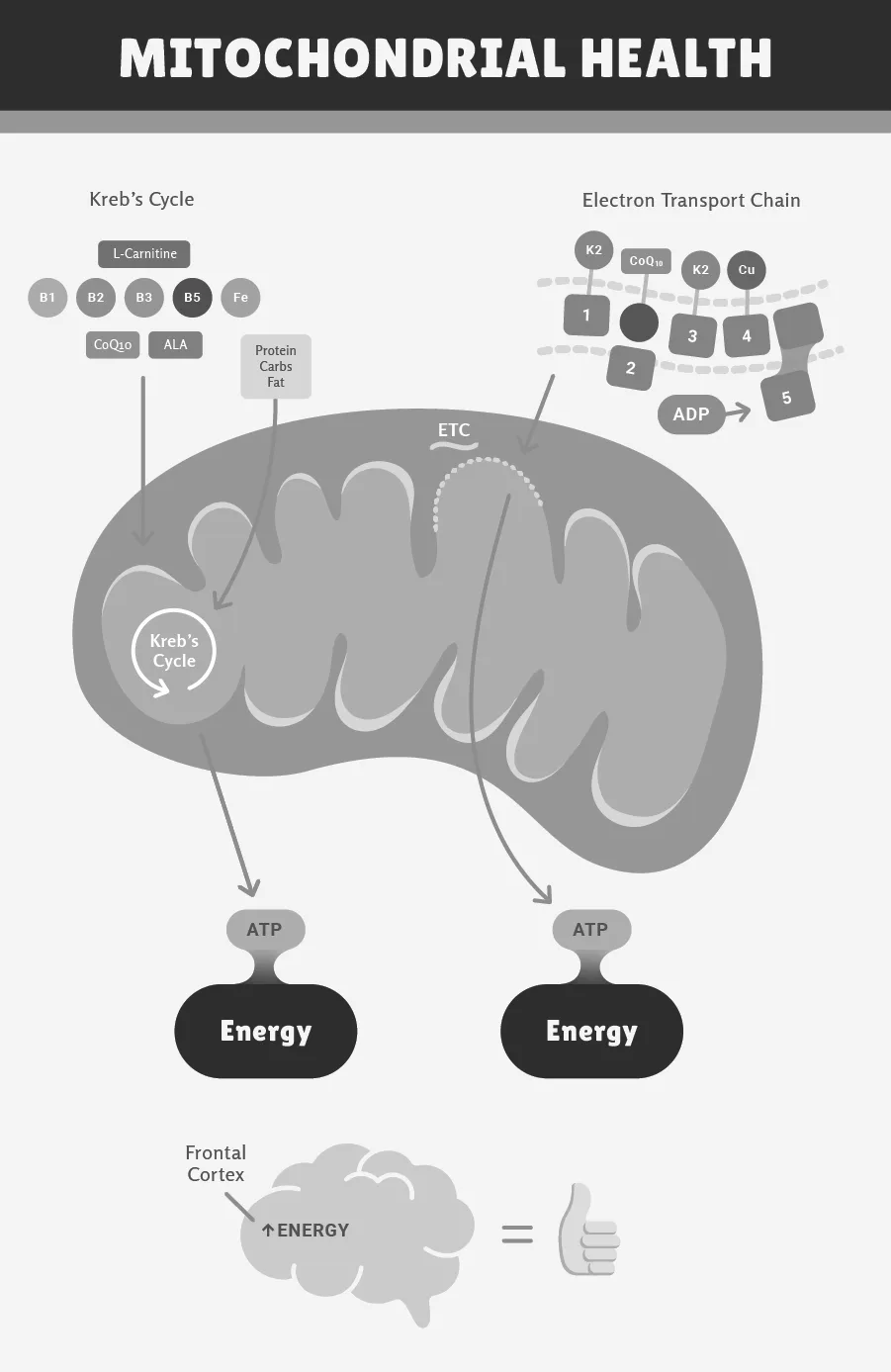
- Glucose, fat, and protein can all act as the raw material for energy creation via the Kreb’s cycle in mitochondria.
- The Kreb’s cycle (Citric Acid cycle) utilizes vitamins and minerals to churn out ATP needed for a very energy dependent brain.
- Massive amounts of ATP are created elsewhere in mitochondria through the Electron Transport Chain
- The Electron Transport Chain requires Vitamin K2, Coenzyme Q10, and Copper.
It may be easy to overlook the value of something that is so pervasive. At the same time, mitochondria are everywhere and in no one place in particular. Yet, mitochondria exist in every cell for a reason. Every cell needs energy. Every organ needs energy. The brain is no exception.
Mitochondria Supporting Nutrients
| Mineral | Function | Food Sources |
|---|---|---|
| Iron | Supports production of ATP in mitochondria | (Heme) clams, oysters, mussels, beef, turkey, chicken (Non-Heme) lentils, chickpeas, black-eyed peas, kidney beans, white beans, black beans, potatoes with skin, raisins, apricots, cashews, almonds, pistachios, tahini, spirulina |
| Copper | Supports production of ATP in mitochondria | oysters, sunflower seeds, dark chocolate, almonds, apricots, crab, octopus, lobster, tuna |
| Magnesium | Supports production of ATP in mitochondria | pumpkin seeds, almonds, peanuts, sunflower seeds, lima beans, plantains, potatoes, black-eyed peas, apricots, edamame, acorn squash, mussels, shrimp, clams, oysters, summer squash, tomatoes, milk, cheese, blackberries, arugula, dark chocolate (70% or greater) |
| Vitamin | Function | Food Sources |
|---|---|---|
| Vitamin K2 | Supports production of ATP in mitochondria | ghee, cheese (pastured/grass-fed), eggs (yolks), pork, oysters, dark chicken, liver |
| Vitamin B1 | Supports production of ATP in mitochondria | tomatoes, edamame, peas, kidney beans, pinto beans, acorn squash, sunflower seeds, tahini, potatoes, milk, peppers, onions, garlic, asparagus, broccoli raab |
| Vitamin B2 | Supports production of ATP in mitochondria | almonds, blueberries, mushrooms, beans, black-eyed peas, kale, edamame, watercress, beet greens, spinach, asparagus, grapes, apricots, plantains, tahini |
| Vitamin B3 | Supports production of ATP in mitochondria | peppers, potatoes, mushrooms, lentils, kidney beans, peas, sweet potatoes, apricots, blackberries, mangoes, plantains, oranges, beef, pork, chicken |
| Vitamin B5 | Supports production of ATP in mitochondria | mushrooms, parsley, spirulina, chives, sundried tomatoes, radish, pasilla peppers, avocados, apricots, dates, eggs, liver, beef, chicken, pork |
| Coenzyme Q10 | Supports production of ATP in mitochondria | liver, beef, EVOO, chicken, herring, tuna, edamame, butter, eggs, avocado, broccoli, cauliflower, cabbage, oysters, oranges, pistachios, walnuts, sesame seeds |
| Nutrient | Function | Food Sources |
|---|---|---|
| L-Carnitine | Shuttles fatty acids into mitochondria to boost ATP production | beef, pork, milk, cod, avocado *L-Carnitine biosynthesized in body from Lysine. Food Sources of Lysine: beef, chicken, pork, fish, milk, cheese, yogurt, eggs, apples, apricots, pears, avocados, pineapple, green beans, asparagus |
| Creatine | Provides short-term energy supply for neurons | beef, pork, milk, cheese, yogurt, eggs, mussels, clams, oysters |
| Alpha-lipoic Acid | Supports production of ATP in mitochondria | Coconut (provides precursor Caprylic Acid) |
Sources cited in this chapter
Numbers match the superscripts above and the book's full reference list.
- 180.Rich, P. (2003). The molecular machinery of Keilin's respiratory chain Biochemical Society Transactions 31(6), 1095-1105. Find it: reference 180 on Google Scholar
- 181.Raichle, M., Gusnard, D. (2002). Appraising the brain's energy budget Proceedings of the National Academy of Sciences 99(16), 10237-10239. Find it: reference 181 on Google Scholar
- 182.Magistretti, P., Allaman, I. (2015). A Cellular Perspective on Brain Energy Metabolism and Functional Imaging Neuron 86(4), 883-901. Find it: reference 182 on Google Scholar
- 183.Collins, A., Koechlin, E. (2012). Reasoning, Learning, and Creativity: Frontal Lobe Function and Human Decision-Making PLOS Biology 10(3), e1001293. Find it: reference 183 on Google Scholar
- 184.Sotres-Bayon, F., Quirk, G. (2010). Prefrontal control of fear: more than just extinction Current Opinion in Neurobiology 20(2), 231-235. Find it: reference 184 on Google Scholar
- 185.Cheng, A., Hou, Y., Mattson, M. (2010). Mitochondria and Neuroplasticity ASN Neuro 2(5). Find it: reference 185 on Google Scholar
- 186.Picard, M., McEwen, B. (2014). Mitochondria impact brain function and cognition Proceedings of the National Academy of Sciences 111(1), 7-8. Find it: reference 186 on Google Scholar
- 187.Sas, K., Szabó, E., Vécsei, L. (2018). Mitochondria, Oxidative Stress and the Kynurenine System, with a Focus on Ageing and Neuroprotection. Molecules (Basel, Switzerland) 23(1), 191. Find it: reference 187 on Google Scholar
- 188.Nunnari, J., Suomalainen, A. (2012). Mitochondria: In Sickness and in Health Cell 148(6), 1145-1159. Find it: reference 188 on Google Scholar
From The Mental Wellness Diet: Ancient Wisdom - Evolving Science - Modern Day Options © 2020 Justin Bethoney NP IPN, Inc.. Published for educational and informational purposes only; it is not a diagnosis, treatment or substitute for professional healthcare. Talk with your own clinician about your health.