
Balanced Excitation
What do holiday decorations, cologne, and friendly advice all have in common? A little goes a long way, and it’s easy to overdo it. Less is more. Decorating for the holidays is a joyous experience. Although, that motorized, hand-waving, light-up Santa Claus you’ve kept on your front lawn all year-round does land just on the wrong side of tasteful. Finding the right balance is ideal.
I’m sure you have tried to offer advice to a friend whose dealing with a problem (or maybe you’ve been the victim of this blessing). You listen well and think to give your honest feedback. Yet, somehow, in drawing reasonable conclusions about the situation, you’ve said too much. Suddenly, you notice the tension building in your friend. Their forceful exhale is deafening. They’re on fire and your eyes begin searching for the nearest exit.
From then on, everything you say on the topic is generally a tight-lipped “mm-hmm” with a nod. Or, if you’re feeling brave, you’ll go with a compliment sandwich. “Good for you for telling your boss he’s a terrible human being to his face and just walking out like that. Seems like it would be good to try and find a new job relatively soon though. I like your shoes?”
When it comes to friendly advice, it’s all about balance. It’s also about knowing your limits. Activity within the brain is no different. As covered in chapter nine, too much excitation is associated with various mental illness symptoms.201,204,219 Excitation is definitely a good thing. But, as we’ll cover more in this chapter, excitation needs to be balanced with a healthy amount of inhibition. So, what does it feel like to have too much excitation going on in the brain?
Changing the Channel
What does it take to overstimulate a brain circuit? There’s a lot to that answer. At this time, not all of the effects of this over-excitation problem are fully known. Luckily, research in the field of psychiatry and brain science is now pointed in that direction.219220 What do we know so far about over-excitation of the brain? First, over-excitation depends on which circuit is being activated. Second, the degree of activation matters.
Here’s the issue: excitation pushes on the gas, overstimulating neurons, and their respective circuits.197,219 As a result, there’s a lot of noise in the brain. With all that extra noise, we can begin to feel mentally and emotionally overwhelmed. We can even feel uneasy in our body. Our attention is all over the place. Our minds are racing. It’s a jumble of thoughts and emotions, most of which, convey a negative tone.
As a side note, the fact that, when overwhelmed, most of our thoughts and feelings are negative actually makes a lot of sense. For us humans to survive, we had to be keenly aware of danger lurking around us. Without that awareness, one by one, our early ancestors would have casually walked up to wild animal, with hopes of initiating a playful wrestling match, only to be promptly mauled by those irresistible furry beasts. Danger sparks fear. Fear drives us to seek safety. In that sense, fear and negativity are gifts. The only problem is that they don’t feel much like gifts when we’re in the thick of it.
Regardless, negativity is the standard operating mode for a reason. As humans, we are able to spend so much of our time outside of that negativity due to the outermost layer of our brains. The outermost layer of the brain, also known as the neocortex (rough translation: the newest part) allows us to perform all of the amazing feats humans are known for. The frontal cortex is one of the major players in this neocortex. By amazing feats, I’m not just talking about juggling flaming swords while riding a unicycle. The outermost layer of our brain can preoccupy us with creativity, deep thought, writing, reading, empathizing, art, music, the beauty of nature, and a bunch of other talents that make us uniquely human.
By preoccupying our minds with all these interesting endeavors, the outermost layer of our brain is able to distract us from all that negativity swirling around in the deeper, more primal parts of our brain. When we are engaged in some sort of higher level of thought, the more basic emotional circuits in our brain are actively being shushed. Again, that’s inhibition at work.
As awesome as that sounds, there will be times when it happens. Negative thoughts and emotions will breach the barrier. They will invade our consciousness. It not only feels awful, it can also catch us by surprise. Despite that darker energy always being there (just below the level of our awareness), it’s a shock when those intense, often negative, thoughts and emotions rise up from within and take over our entire consciousness. In that moment, it’s bewildering.
It’s overwhelming and we just want it to stop. We want to change the channel. So, we reach for things that can hit the brakes. Unfortunately, many of those things can be counterproductive for our mental health. They work in the moment, but at a cost down the road.
Which things do we tend to reach for? What can, at least temporarily, bring down the intensity level? Mostly, it’s the stimulating substances like nicotine, caffeine, amphetamines, or it’s the sedating substances like alcohol, marijuana, and other medications with similar effects (opiates and benzodiazepines). Carbohydrate binges can also sometimes do the trick. In addition, there’s a multitude of avoidance behaviors like oversleeping, procrastinating, and indulging in hedonistic pleasures that can help change the channel in the moment. These are all common things we instinctively reach for to dial back our reactions to life.221
It’s not good for us, but often we can’t help it. Again, we are programed for safety. When those behaviors or substances change the channel, they temporarily blind us to fear and release us from negativity. We can delude ourselves into thinking that the monster will go away. It kinda works. But in the end, these channel changers provide us with just a false sense of security.
Clearly, channel changing is not an optimal strategy, especially when it involves dependence on addictive substances. Although, closing our eyes and turning away in tough moments is part of human nature. It’s our obligatory survival instinct at work. Think about what happens when we’re driving down the road and something jumps out in front of us. What do we do? Instinctively, we close our eyes, turn our face to the side, and put our hands up in front of our face. Sometimes, in order to get through the day, we have to look away. We have to check out.
In addition to chronic inflammation, stress can overstimulate our brain. Stress opens the door for excessive excitation. It does so by wearing down our neocortex. Episodes of heightened stimulation and stress deplete our energy and resources. In this scenario, there’s little energy and resources leftover to fuel inhibition. During stressful times, we feel distracted, impulsive, overflowing with emotions, and even harbor intrusive anxious or aggressive thoughts. It’s all too much. When it strikes, we don’t know what else to do. We’ve got to dial it back from a level 10 somehow.
Imagine if we could find a way to eat, move, think, and live that could bolster our energy and resources. Imagine if we could build up a reserve of energy and resources dedicated towards inhibition. Imagine if we could live in a way that aims to constantly limit excitation and thereby prevent these overwhelming emotional upwellings before they got a chance to gain momentum. Well, that way of life would be everything described here in the TMWD (see chapter four). A well-fed brain has more resources to dedicate to inhibition. A major premise of this book is that a well-fed brain has a greater ability to quell intense fear and overwhelming emotions. A well-fed brain sidesteps the need to change the channel.
This brings us back to the analogy of the cable box. How many channels does your cable box receive? A thousand? How many channels will your cable box push through at one time? One. Your cable box has to suppress 999 channels to let just one channel pass on through to your TV. We want our mind to work like that. We want to be able to choose the channel that we are watching at any given moment. To accomplish that, we need our brain to be able to suppress, block, mute, shush, and tame all the channels that we don’t want to watch. One thing at a time. One strong, consistent signal. Minimal background noise.
It’s not just intense emotions that can result from relative excess excitation in the brain. Plain old distractibility and brain fog are two other consequences of an imbalance between excitation and inhibition in the brain. Inhibition helps quiet the noise so you can hear the signal. On the other hand, if your overly inhibited (possibly from a sedating substance or some sort of nutritional/chemical imbalance), there won’t be enough excitation to push through any one signal. That’s not ideal either.
Here’s a deep thought. In life, you want to be able to focus on what you want to focus on. Stay with me here. At the beginning of any task or interaction with another, you start out trying to focus on whatever you feel is most important. Without adequate inhibition, other environmental stimuli will emerge from the periphery. Like a litter of piglets pushing each other aside for access to their mother’s utters, everything around us and in our minds can easily push aside that thing that we originally wanted to focus upon. All the less important environmental stimuli and our internal dialogues can pull, tug, beg, persuade, entice, and even bully our attention into jumping over to another signal. Typically, without adequate inhibition to protect the original signal, something else can enter center stage – something more interesting or more intense – even when we don’t want it to.
Competing environmental stimuli can suck you into a hazy vortex where everything captures your attention, but nothing is in focus. The background noise should have been muted, but it wasn’t. Now you’re in free float. Competing external and internal stimuli deliver you into a fog of distractibility. Scattered attention stems from all that excessive excitation that hasn’t been properly filtered by inhibition.
As mentioned in chapter eight, inhibition in the frontal cortex is important for giving us pause. Inhibition helps us stop and think before we react impulsively.184,219 That millisecond of uninterrupted focus is what allows us to remain productive. In the frontal cortex, inhibition allows us to focus on the task at hand. We want that ability to pause.
Beyond preventing distractions, the frontal cortex also helps us cope with stress. It does so by taming the brain’s fear center. That allows us to take a second to breathe before we drown in an uncomfortable emotional soup.222 It helps us momentarily resist that internal fear that tries to convince us that it’s all going to end very badly unless we react right now.222 A level 10 threat requires a level 10 reaction, right? The frontal cortex hits the pause button and offers us a moment of poise to reconnect with our purpose. The tool it employs to deliver us this gift is inhibition.
As you may have gathered by now, it’s tough out there in modern-day life. Numerous environmental factors in modern life can overstimulate and agitate our nervous223-224 and immune systems.225- 226 Yet, our human brain has the capacity to handle a fair degree of stress and distraction while maintaining our focus, productivity, and a degree of calm.
Thanks to inhibition, we can mentally and emotionally walk and chew gum at the same time. For those of us experiencing more intense distractibility, anxiety, depressed moods, and all other kinds of mental illness symptoms, it’s liberating when we can find a way to do what we need to without being dragged down by all the stuff going on in our brains. Those days, when it all works, our inhibition game is strong. That’s when we experience the peace of a singular signal amidst a low level of distracting background noise.
As with everything, balance is key. We have established that when it comes to chemical and electrical activity in the brain, inhibition is equally as important as excitation. The balance of both allows for balance in our lives.227
Fast and Furious
In order for us to feel well and function optimally, the electrical activity in our brains need to find a balance between excitation and inhibition.219 Let’s return to the driving analogy. Our cars have two pedals: gas and brake. If your car only had a gas pedal (excitation), and no brake (inhibition), that would be problematic. With just a gas pedal to work with, you wouldn’t make it very far before you crashed into something. The brake is necessary. It helps us slow down so we can stop when we need to, avoid danger, and steer ourselves in the right direction.
Inhibition is about tapping on the brakes as you bend into the turns. Gently tapping on the brakes allows you to continue moving forward, but in a controlled way. This way we can steer in the direction that we want to go. We need inhibition (the brake) as a counterbalance at certain times and places, as well as to certain degrees. You wouldn’t slam on your brake and come to a dead stop, then make your turn. Inhibition is not about a full stop. It’s more like a light tap on the brake to ease you into the turn. Inhibition is a gentle, but powerful form of control.
However, we can’t forget about excitation (the gas pedal). The gas pedal takes us places. Without it, the car would be useless. Excitation mediates all our brain functions. It helps us learn, memorize, problem solve, adapt, and process our emotions.228 Without excitation we’d be useless blobs. The take home point here is that unopposed excitation is a common problem that leads to a lot of mental and emotional unrest. 219 A balance between the two is essential.
When it comes to balance in the brain, we should all be like my Aunt. She loves driving with both feet. As a side note, there’s definitely going to be a family meeting after this book is published. Intermittently my Aunt will tap on the gas with her left foot, but she’s always working the brake with her right – just in case. This makes for a complicated relationship between my Aunt and her mechanic, but she’s okay with it. Two feet driving helps her feel like she’s in control.
This may not be the best way to maintain the life of our cars, but it’s an effective strategy for managing our brain activity. A consistent tap on the brake helps us maintain stability in this crazed modern-day life. A healthy balance between the gas and brake in our brain helps us feel active and engaged, but also in control. This balance ensures that we stay aware and safe, but we don’t overdo it with fear or negativity.
House of Cards
As noted, inhibition doesn’t shut us down completely. Just a little pressure in the opposite direction of excitation does us a world of good. Like your favorite pair of skinny jeans, inhibition is a gentle, but constant pressure.
Our human brain developed this very elaborate network of checks and balances over time. It’s a delicate system of inhibitory neurons intersecting with excitatory ones. The inhibitory neurons, interlaced with the excitatory neurons, are poised to tap on the brake when our excitatory neurons get too revved up. When the brain is functioning optimally, it’s a house of cards. The brain strikes a balance between response and non-response.
The risk we face in modern-day life – from all the inflammation-promoting foods, toxins, and stress – is the overstimulation of our brain. Our brains possess a massive potential for excitatory reaction, and these environmental stimuli turn that potential into reality.229-230 If we’re fortunate, inhibition will be there as the traffic officer in a busy intersection. It will let the excitatory signals it deems most important at that moment come on through, but block, mute, and filter out the rest. If inhibition can adequately put excitation into check, it will help us feel and act more in control.231 This inhibitory counterbalance to excitation in the brain is vital to our mental stability and emotional regulation.231 Again, the balance of both allows for balance in our lives.227
The key to success is to support our inhibitory mechanisms with diet and lifestyle. At the same time, we need to try our best to avoid the toxic environmental factors that trigger excessive excitation. For most neurons, excitation is mediated by common electrolytes – sodium, potassium, calcium, and chloride. The body does a great job at conserving (as well as regulating the levels of) these electrolytes. For most of us, there’s no need to worry about getting enough of these electrolytes from the diet. Even in the Western pattern diet, it’s not hard to consume enough. And, these electrolytes are also plentiful in TMWD. But, consuming more may be a good idea if you exercise often, sweat a lot, or live in a dry climate.
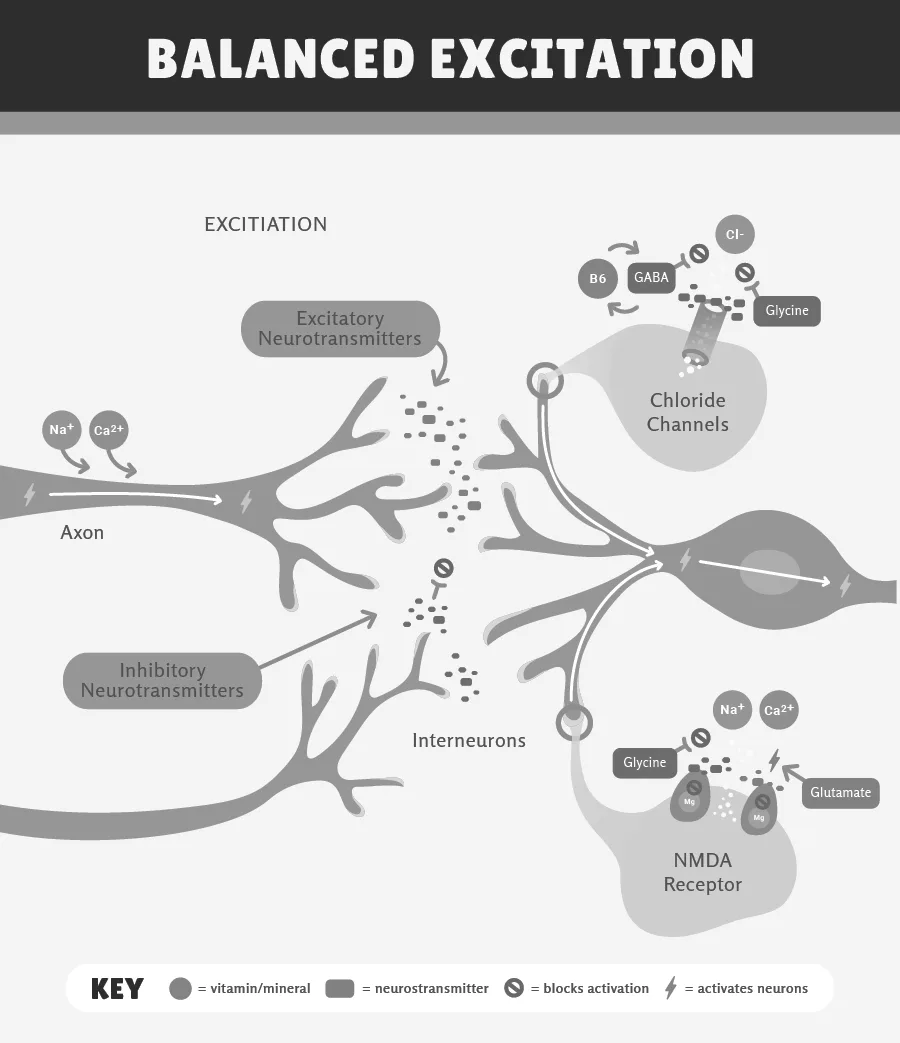
- The inhibitory brakes on excitation include the inhibitory neurotransmitters GABA (gamma aminobutyric acid) and glycine, as well as other key nutrients that directly limit excess excitation.
- Sodium and Calcium are needed for normal electrical activity in the brain.
- Vitamin B6, the amino acids Taurine and Glycine, as well as the minerals Magnesium and Zinc act as buffers against excitation.
What are the nutrients that support inhibition? First, it’s important to note that gamma aminobutyric acid (GABA) is the primary inhibitory neurotransmitter. It’s massively important for inhibition. As you can imagine from the description of excitation and inhibition above, GABA is being utilized all the time. With so much use, the supply of GABA is at risk of becoming depleted. Vitamin B6 plays a critical role recycling GABA, so it can be there to help out with inhibition when the brain needs.190,232
Similarly, the amino acid glycine can step in and function as an inhibitory neurotransmitter.233 The amino acid taurine enhances the activity of GABA receptors.234 Both of these amino acids make it harder for excitatory receptors to fire those excitatory neurons. They don’t fully block excitation. In their own way, they pull back on the excitatory throttle.
Then there are a couple of key minerals that provide a similar counterbalance against excitation. Magnesium squeezes inside the excitatory receptors (known as NMDA), thus restricting the ability of the receptors to activate those neurons.235–236 Zinc binds to the outer aspect of NMDA receptors, deactivating them, and thus diminishing the excitatory activity in the brain.237 Again, these key nutrients do not bring excitation to a full stop. They just tap on the brake, so the brain doesn’t go overboard.
Outside of nutrition, meditation and mindfulness can definitely make a difference. With regular practice you can get better at bringing your attention back to what you want through calming your mind and body. To review, the goal of mindfulness practice is not to instantaneously deliver you to a place of serenity and peace each and every time. Meditation and mindfulness practice is hard work. It’s often an uncomfortable struggle, just as learning how to ride a bike is challenging for a kid. Through practice of non-attachment, we can train our brain to get better at inhibiting thoughts and feelings that inevitably bubble up. This enhances our ability to focus and regulate our emotions in the future.
Brain Balancing Nutrients
| Vitamin | Function | Food Sources |
|---|---|---|
| Vitamin B6 | Recycles inhibitory neurotransmitter GABA | pasilla peppers, red peppers, chives, shallots, onions, parsley, garlic, leeks, prunes, apricots, bananas, eggs, cheese, tuna, salmon |
| Glycine | Acts as inhibitory neurotransmitter | bone broth, collage peptide powder |
| Taurine | Acts as inhibitory neurotransmitter | dark chicken/turkey meat, beef, pork, lamb, salami, tuna, mussels, clams, scallops, squid, oysters |
| Magnesium | Protects against overstimulation of excitatory neurons | pumpkin seeds, almonds, peanuts, sunflower seeds, lima beans, plantains, potatoes, black-eyed peas, apricots, edamame, acorn squash, mussels, shrimp, clams, oysters, summer squash, tomatoes, milk, cheese, blackberries, arugula, dark chocolate (70% or greater) |
| Zinc | Protects against overstimulation of excitatory neurons | oysters, beef, pumpkin seeds, lobster, lamb, pasilla peppers, edamame, garlic, chickpeas, black-eyed peas, pinto beans, broccoli raab, mushrooms, fish, dark chocolate |
Sources cited in this chapter
Numbers match the superscripts above and the book's full reference list.
- 1.Aarts, E., Ederveen, T., Naaijen, J., Zwiers, M., Boekhorst, J., Timmerman, H., Smeekens, S., Netea, M., Buitelaar, J., Franke, B., Hijum, S., Vasquez, A. (2017). Gut microbiome in ADHD and its relation to neural reward anticipation PloS one 12(9). Find it: reference 1 on Google Scholar
- 2.Cenit, M., Sanz, Y., Codoñer-Franch, P. (2017). Influence of gut microbiota on neuropsychiatric disorders World Journal of Gastroenterology 23(30), 5486 -5498. Find it: reference 2 on Google Scholar
- 3.Cenit, M., Nuevo, I., Codoñer-Franch, P., Dinan, T., Sanz, Y. (2017). Gut microbiota and attention deficit hyperactivity disorder: new perspectives for a challenging condition European child & adolescent psychiatry 26(9), 1081 -1092. Find it: reference 3 on Google Scholar
- 4.Kelly, J., Kennedy, P., Cryan, J., Dinan, T., Clarke, G., Hyland, N. (2015). Breaking Down the Barriers: The Gut Microbiome, Intestinal Permeability and Stress-related Psychiatric Disorders Frontiers in Cellular Neuroscience 9(2), 215. Find it: reference 4 on Google Scholar
- 5.Mitchell, R., Goldstein, B. (2014). InflammationinChildrenandAdolescentsWith Neuropsychiatric Disorders: A Systematic Review Journal of the American Academy of Child and Adolescent Psychiatry 53(3), 274 - 296. Find it: reference 5 on Google Scholar
- 6.Raison, C., Capuron, L., Miller, A. (2006). Cytokinessingtheblues:inflammation and the pathogenesis of depression Trends in Immunology 27(1), 24 - 31. Find it: reference 6 on Google Scholar
- 7.Berk, M., Williams, L., Jacka, F., O’Neil, A., Pasco, J., Moylan, S., Allen, N., Stuart, A., Hayley, A., Byrne, M., Maes, M. (2013). So depression is an inflammatory disease, but where does the inflammation come from? BMC medicine 11(1), 200. Find it: reference 7 on Google Scholar
- 8.Vogelzangs, N., Beekman, A., Jonge, P., Penninx, B. (2013). Anxietydisorders and inflammation in a large adult cohort Translational psychiatry 3(4), e249 - e249. Find it: reference 8 on Google Scholar
- 9.Pitsavos, C., Panagiotakos, D., Papageorgiou, C., Tsetsekou, E., Soldatos, C., Stefanadis, C. (2006). Anxiety in relation to inflammation and coagulation markers, among healthy adults: The ATTICA Study Atherosclerosis 185(2), 320 - 326. Find it: reference 9 on Google Scholar
- 19.Finkelstein, J. (1990). Methionine metabolism in mammals The Journal of Nutritional Biochemistry 1(5), 228 - 237. Find it: reference 19 on Google Scholar
- 20.Meléndez-Hevia, E., Paz-Lugo, P., Cornish-Bowden, A., Cárdenas, M. (2009). A weak link in metabolism: the metabolic capacity for glycine biosynthesis does not satisfy the need for collagen synthesis Journal of Biosciences 34(6), 853 - 872. Find it: reference 20 on Google Scholar
- 22.Milton, K. (1999). A hypothesis to explain the role of meat‐eating in human evolution Evolutionary Anthropology: Issues, News, and Reviews 8(1), 11 - 21. Find it: reference 22 on Google Scholar
- 30.Course, M., Wang, X. (2016). Transporting mitochondria in neurons F1000Research 5(1735), 1735 - 10. Find it: reference 30 on Google Scholar
- 184.Sotres-Bayon, F., Quirk, G. (2010). Prefrontal control of fear: more than just extinction Current Opinion in Neurobiology 20(2), 231-235. Find it: reference 184 on Google Scholar
- 190.Kennedy, D. (2016). B Vitamins and the Brain: Mechanisms, Dose and Efficacy —A Review Nutrients 8(2), 68. Find it: reference 190 on Google Scholar
- 197.Block, M., Zecca, L., Hong, J. (2007). Microglia-mediated neurotoxicity: uncovering the molecular mechanisms Nature Reviews Neuroscience 8(1), 57-69. Find it: reference 197 on Google Scholar
- 201.Patel, A. (2013). Review: the role of inflammation in depression. Psychiatria Danubina 25 Suppl 2(), S216-23. Find it: reference 201 on Google Scholar
- 204.Réus, G., Fries, G., Stertz, L., Badawy, M., Passos, I., Barichello, T., Kapczinski, F., Quevedo, J. (2015). The role of inflammation and microglial activation in the pathophysiology of psychiatric disorders Neuroscience 300(), 141 - 154. Find it: reference 204 on Google Scholar
- 219.Page, C., Coutellier, L. (2019). Prefrontal excitatory/inhibitory balance in stress and emotional disorders: Evidence for over-inhibition Neuroscience & Biobehavioral Reviews 105(), 39-51. Find it: reference 219 on Google Scholar
- 231.Nicoll, R. (2017). A Brief History of Long-Term Potentiation Neuron 93(2), 281- 290. Find it: reference 231 on Google Scholar
- 232.Huang, Y., Su, L., Wu, J. (2016). Pyridoxine Supplementation Improves the Activity of Recombinant Glutamate Decarboxylase and the Enzymatic Production of Gama-Aminobutyric Acid. PloS one 11(7), e0157466. Find it: reference 232 on Google Scholar
- 233.Branchereau, P., Cattaert, D., Delpy, A., Allain, A., Martin, E., Meyrand, P. (2016). Depolarizing GABA/glycine synaptic events switch from excitation to inhibition during frequency increases Scientific Reports 6(1), 21753. Find it: reference 233 on Google Scholar
- 234.Wu, J., Prentice, H. (2010). Role of taurine in the central nervous system Journal of Biomedical Science 17(Suppl 1), S1 Find it: reference 234 on Google Scholar
- 235.Johnson, J., Ascher, P. (1990). Voltage-dependent block by intracellular Mg2+ of N-methyl-D-aspartate-activated channels Biophysical Journal 57(5), 1085-1090. Find it: reference 235 on Google Scholar
- 236.Ruppersberg, J., Kitzing, E., Schoepfer, R. (1994). The mechanism of magnesium block of NMDA Seminars in Neuroscience 6(2), 87-96. Find it: reference 236 on Google Scholar
- 237.Mlyniec, K. (2015). Zinc in the Glutamatergic Theory of Depression Current Neuropharmacology 13(4), 505-513. Find it: reference 237 on Google Scholar
From The Mental Wellness Diet: Ancient Wisdom - Evolving Science - Modern Day Options © 2020 Justin Bethoney NP IPN, Inc.. Published for educational and informational purposes only; it is not a diagnosis, treatment or substitute for professional healthcare. Talk with your own clinician about your health.