
Neurotransmitter Metabolism
Adapt or die. It’s harsh, but true. If Game of Thrones has taught us nothing, it has left us with the understanding that when everything is falling apart at the end of an epic TV series, that would be the time to pause and try to find another TV show to binge afterwards so that you don’t get stuck in devastating show hole when it’s all over. In life, being aware and staying on the move are keys to success. You’ve got to set up a rebound show ahead of time. That’s how you adapt.
As the annoying therapist saying goes, “in life we can’t always choose our circumstances, we can only choose how we respond to them.” For many of us, difficult life events can shuttle us directly into painful emotional states – sadness, frustration, despair, overwhelm, basically a kaleidoscope of negativity.
Grief is a classic example of how this works. When a loved one dies, we immediately go into a short period of shock. Then we crawl through a much longer period of sadness, anger, and longing. Typically, it’s a long time before we are able to move on from these painful emotional states.
Other life stressors are less sudden, more drawn out. Yet, that doesn’t make them any less intense. Often, it’s because these stressors are lingering and persistent that they are so mentally and emotionally challenging. Financial difficulties, strained relationships, self-esteem & body image issues, and all forms of oppression fall under this category of chronic life stressors.
These chronic life stressors are so hard on us because they can feel as if life is unfair, as if we aren’t good enough, as if something or someone is pushing us down, or that our destiny is just outside of our control. On another level, due to the way in which these stressors are chronic and unrelenting, we can begin to feel like we never get a break. In facing such circumstances on a daily basis, we can easily get stuck in negative emotional states.
What happens when we live with negative emotional states for too long? Those negative emotions can take on a life of their own. They can change the way that we see the world, hear the words of those around us, and even perceive ourselves. Stress that persists for too long can easily cast shadows of negativity that follow us around like lost puppies. These negative emotional states that become our permanent shadows of shame, guilt, and self-doubt. They are the seeds that blossom into mental illness later on down the road.
So, we have to find a way to cope. The best coping style will vary from person to person. No one strategy is the absolute best. We just need to find a way out of those negative emotional states that have a way of sucking us in. If we can’t find a way to defend ourselves, and these life problems persist, we will find ourselves swimming in negative emotional states day in and day out.
Our human brains can handle a lot of stress. But there is a limit. That point in time when we reach our limit, is where mental illness symptoms are likely to emerge. When faced with these negative emotional states, seeing a therapist, speaking with a pastor, or reaching out to friends and family are good things to try (if available). A therapist, or our most therapeutically oriented friend, can help us pause, step to the side, and see things from a different angle. Just sitting with our thoughts can be transformative as well. Time spent reflecting moves our thoughts from a dark and doubtful place to a mindset that allows for more possibility. When we let it marinade for a while, we gain perspective.
With new and different and more informed perspective, we can begin to see a way out. This way out was likely always there. It’s just that when these negative emotional states and self-doubting thought patterns cast their shadows, the door handle to the escape hatch is invisible to us. Like a secret staircase hidden behind bookshelf, it’s right in front of us, but we can’t see it.
When it comes to negative emotional experiences, even the mere passing of time can help. Generally, time passing will help the pain fade. With time, we turn around, look back, and realize that somehow the pain has magically departed. Or rather, the pain stayed in place, and we moved on. Either way, time creates space between us and those negative emotional states. This time and space helps us respond to our problems in a much more constructive way. All of these approaches – friends, therapy, spirituality, self-reflection, and even the passing of time – can help. What they all have in common is movement.
Initially when we are experiencing negative emotions like sadness, despair, fear, worry, or anger, we are glued to the pain. There’s nothing else on our minds. We are breathing it in. In that moment, there is little to no space between us and it. That’s obviously not an ideal scenario.
When we talk it out, sit and reflect, or allow time to pass, the pain forces movement in our minds. Our thoughts move. Our feelings move. Even our memories move. These coping strategies create a wedge between us and the pain. They move us away from the negative emotional state that first accompanies the difficult circumstances. They move us out of negativity into a neutral acceptance of what is. They move us towards options, possibilities, and a life that’s a much better fit for us.
How we respond to life is what matters most. Life is stressful, and we are emotional beings. That’s a recipe for dissatisfaction, discomfort, and drama. Can you name one reality TV show that didn’t capitalize on these two ingredients? Life will unfold, and as it does, it usually finds a way to push our buttons. Something happens. We feel something. We respond.
Our actions are usually influenced by what we are feeling at the moment. If we’re angry, we lash out – and feel super justified in doing so. If we’re sad or anxious, we retreat. If we’re feeling joyous, we seek to connect. The point is that life stress can steer us down the path towards those negative emotional states. Staying mentally and emotionally well is about course correcting. So how do we do that?
In our journey towards improving our mental wellness, feelings will be useful. They are guideposts along the way. When something bad happens, we typically feel bad. Once we get to feeling negative, that’s when things can take a left turn. Here we have to be careful. A negative emotional state won’t always tell us the truth. Instead it may just tell us something that selfishly makes its own existence seem so real and justified. This is why the words we utter in anger feel like the truest thing we’ve ever said aloud – at least that’s how we feel in that moment. Yet, if we listen to these feelings in a certain way, they can help guide us in the right direction.
Rather than immediately going with negative emotional states when they arise, it’s clearly better to take a beat, be curious, and ask some “why” questions. When we reflect on why we feel certain negative emotional states, this then gives us the freedom to choose a different direction for the future. Often that different direction is avoiding certain people or places, setting stronger boundaries with those we can’t avoid, and finding people and situations that are a much better match for us. Listening to our feelings, accepting them, and heeding their wisdom aids us in making the tough, but important decisions for ourselves. The best kind of feelings are the ones that smoosh what we know to be true, but don’t want to accept, right into our faces.
When we acknowledge what we are feeling, then decide against going down the direction that led us to the negative emotional state in the first place, life gets easier. We need emotional responses to help guide our choices in life. They are our teacher. When we listen to our feelings, they move from within us, to outside of and separate from us.
In summary, we cannot choose our fates. We can only choose how we respond. And the best response to any stressor is attention and movement. A negative, limiting, and destructive emotional state keeps us stuck in place. Negative, limiting, and destructive emotional states fuel similarly negative, limiting, and destructive thought patterns. Negative, limiting, destructive thought patterns in turn will dictate our actions and choices in life – often leading us to react in ways that recreate the scene. Humans are really good at recreating disastrously unhealthy scenes. Unfortunately, there can be a comforting sense of familiarity that accompanies certain bad things happening in our lives. It’s the familiarity that draws us in. At times, we almost instinctually gravitate towards those same scenes in our minds. We return to the same scenes that originally spawned the initial negative, limiting, and destructive emotional states. Technically speaking, it’s called a circle. And, our minds can easily get trapped in them
Negative emotional states are greedy and selfish. They want to be felt all the time. They want you to feed on what they put in front of you. They want you to pay attention to them and nothing else. If we comply, we’re stuck. The best response is to break up the concrete and allow your thoughts and feelings the space to move around a bit.
Like a children’s magician pulling a quarter out from behind a kid’s ear, we need to reach inside, grab ahold of those intense feelings, pull them out, give them a quick glance, then with a bit of flare, wave a wand over them and blow the dust off our palm as we let the hurts dissipate into the atmosphere. When we step back and get that outside perspective, we can see possibilities. When we step out of negative emotional states, we can then choose a different option. This is the difference between reacting and responding. Reacting is riding on pure emotions. Responding is a more calculated and conscious process. When we create this space between us and these intense feelings, we usher in a wealth of composure, wisdom, and sound decision making. It’s movement. It’s us moving in a better direction.
First Responders
As we’ve learned, in life stuff happens. Then we experience an internal response to whatever stuff just happened. It takes a moment, but all that stuff happening around us produces an assortment of electrical and chemical responses. These responses can then trigger a memory, unleash an emotion, or spark a familiar thought pattern. In the end, the responses culminate in a feeling state.
What’s the link between things happening in the outside world and our internal felt responses? Neurotransmitters. They are the first responders on the scene. They are the bridge between the stuff happening all around us and our internal mental and emotional reactions. Most of the discussion so far has centered on examples of stressful events and the negative emotional experiences they engender. However, neurotransmitters can also help us respond in ways that bring us joy, peace, and personal growth. It all depends on where, how much, and how active neurotransmitters are in our brains. On the whole, deficits of certain neurotransmitters tend to make us more reactionary and emotional. An adequate supply and activity of neurotransmitters tends to help us respond in ways that are healthier and more productive.
Let’s dig a little deeper to see how all of this works inside the brain. Just like we want our emotions to move in order to create change in our lives, neurotransmitters literally move from one spot to another in the brain to make a thought or feeling happen. So, even our brains’ response to life occurs because of movement. Neurotransmission is that movement. The movement is both chemical and electrical.
The chemical part is the variety of neurotransmitters that circulate throughout the brain and act on neurons. There are over a hundred different kinds of neurotransmitters. As far as we know now, however, there’s a small collection of common neurotransmitters that help manage our mental and emotional responses to life. You have likely heard of the popular ones... serotonin, dopamine, norepinephrine. What they all share in common is that they move. Neurotransmitters jump from one neuron to the next. That movement marks the beginning of the emotional responses in the brain, and body.
Once a neurotransmitter docks with a receiving neuron, then the electrical part happens. If enough neurotransmitters float across and activate a receiving neuron, then there is an electrical change that occurs inside the neuron, which is called depolarization. Once the end of the neuron is depolarized, an electrical signal shoots down the length of the neuron. The signal eventually reaches the end terminal of that neuron. Once the electrical signal reaches the end terminal, another electrical change occurs which triggers the release of neurotransmitters from the neuron. As you may have guessed, those neurotransmitters then float across to the next neuron, and the cycle continues.
These chemical and electrical activities are all forms of movement. With all that movement, our brain is responding to life and all that is happening around us, and even within us. It makes sense then, that neurotransmitters have been a central focus of mental health treatment for several decades.115–117 Yet, despite their critical importance, neurotransmitters aren’t the be all-end all of mental health treatment. There are days when us psychiatric prescribers wish that were so. Our jobs would be easy. If all it took to get people better was adjusting neurotransmitter levels and function, then it would literally only take one visit to get people fixed up and on their way. In reality, it’s not that easy. Many other factors come into play.
However, finding ways to leverage control over neurotransmitter activity does impact our emotional lives and can definitely help. Adjusting the levels and activity of neurotransmitters with medication does lead to significant changes in how we experience life. Serotonin, dopamine, norepinephrine are the neurotransmitters commonly targeted with medications. Manipulating them with psychiatric medications does indeed alter the way we think and feel.118–119
In this chapter we will cover how neurotransmitters mediate our response to life. The remaining chapters will cover additional brain structures and functions that shape how we think and feel.
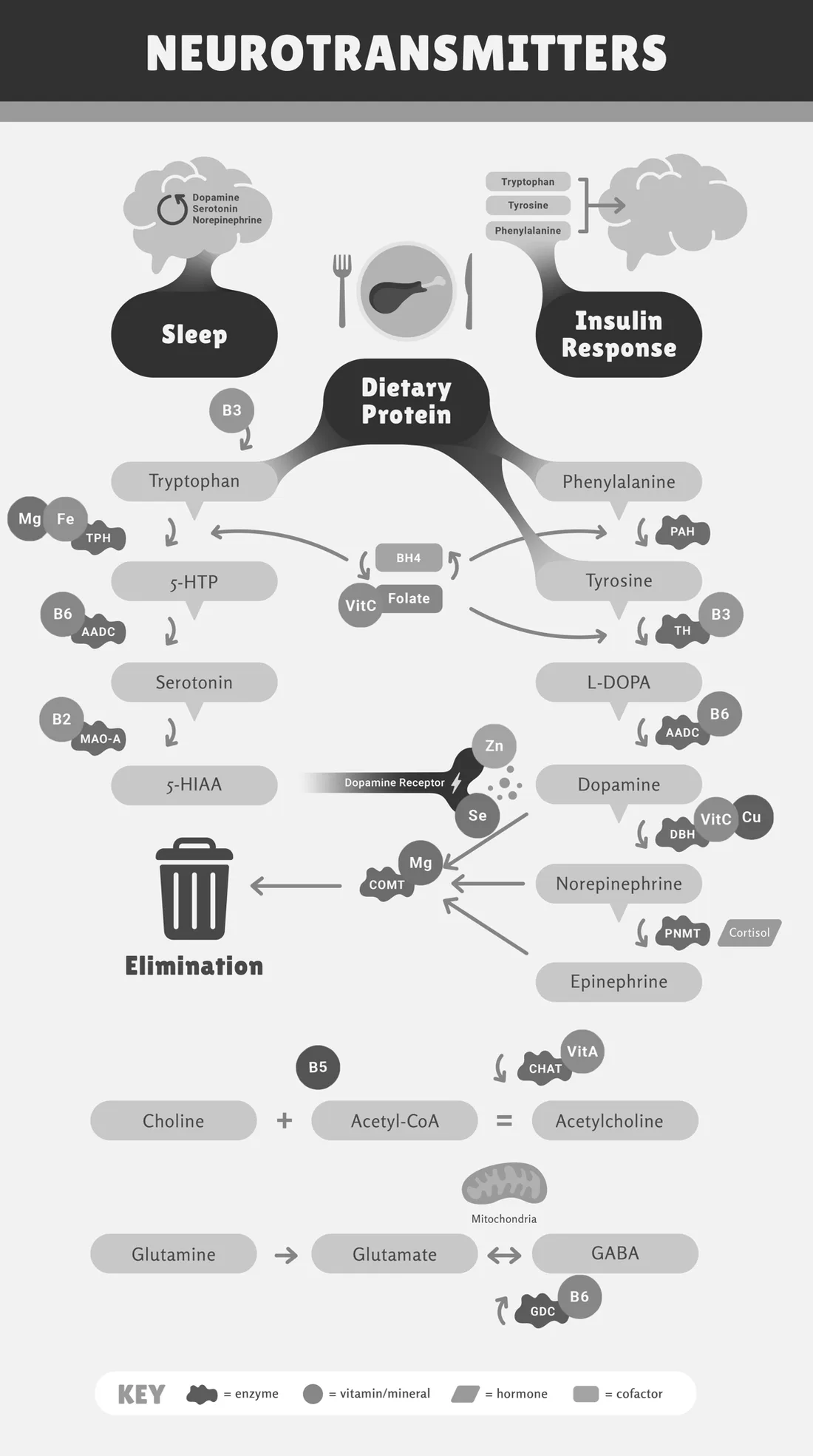
- Sleep helps regenerate key neurotransmitters.
- Dietary protein is important for delivering tryptophan, tyrosine, and phenylalanine, and other amino acids to the brain for the creation of neurotransmitters.
- Insulin responses after meals help shuttle amino acids into the brain for the production of serotonin, dopamine, norepinephrine, and other neurotransmitters.
- The assembly line for neurotransmitters depends on fully functional enzymes (TPH, AADC, PAH, TH, DBH), and these enzymes need specific vitamins and minerals to function.
- Once neurotransmitters are made and have done their job, they need to be degraded and eliminated – there are enzymes for that as well (MAO-A, COMT), which again require specific vitamins and minerals to function optimally.
- Receptors for neurotransmitters also need specific minerals to function optimally (ex: zinc and selenium help sensitize dopamine receptors).
Lettuce Answer the Question
What happens to our brain chemistry if we eat poorly? Take a look at the diagram above. We can start at the top. Notice how neurotransmitter production begins with adequate sleep and protein intake from our daily diet. In addition, insulin helps shuttle amino acids into the brain. Along the neurotransmitter production assembly line, key vitamins and minerals help speed up neurotransmitter production at specific spots. Finally, after neurotransmitters are put to use, the necessary breakdown of neurotransmitters is supported by yet more vitamins and minerals.
As depicted, neurotransmitters are made up of amino acids that we obtain through consuming dietary protein.120 On the most practical level, we need to eat (and absorb) enough protein to have enough amino acids to produce enough neurotransmitters in our brain.121 In a sense, it is very simple. Neurotransmitters can’t do their job in the brain if they are in short supply.
For example, in a few studies where researchers depleted the amino acid tryptophan (the raw material for serotonin) subjects immediately experienced depressed mood states.122 Similarly, depletion of tyrosine and phenylalanine (raw material for dopamine) produced a decrease in motivation, reward seeking, and risk taking.123 Now you can see how nutrition plays such an important role in neurotransmitter creation and function.
Circuit Training
It’s important to have a healthy supply of neurotransmitters at the ready – not too little, not too much. Maintaining the right ‘levels’ of neurotransmitters is not the whole story. There’s more to the neurotransmitter function than just the total amount someone has in their brain. It’s similar to your bank account. Having a lot of money or a little (or even a negative amount), does not always dictate your spending. How you spend money is based on many factors, not just on the dollar amount in your bank account.
If we want to dig a little deeper into how these neurotransmitters mediate our response to life, let’s pick up where we left off in the explanation of how neurotransmission works. To review, for the brain to respond to life happening around us, neurons need to talk to one another. One neuron sends a message, another neuron receives the message, and then that neuron passes it along to the next in line. Each neuron continues to pass along the message to another nearby neuron. It happens in rapid succession, from one part of the brain to the other – at incredible speed. This message sending and receiving in the brain is called neurotransmission. It’s chemical, then electrical, then chemical again.
Neurotransmitters are the chemicals. They are stored in tiny sacs in the end terminals of neurons. They sit and wait for the electrical signal to come down the neuronal pipeline. Once the electrical signal travels down the neuron and hits the end terminal, neurotransmitters are then released into the tiny space between two nearby neurons. This tiny space is called the synapse. Neurotransmitters float across that synapse and snuggle into receptors on the nearby neuron. If enough receptors on that nearby neuron are activated by enough neurotransmitters, then an electrical message is sent along down that next neuron.124
That last part is important. Just one single neurotransmitter floating across and docking with a receptor on another neuron won’t be nearly enough to get the job done. There needs to be a whole gaggle of neurotransmitters squirting out across the synapse and docking with the receiving neuron’s many receptors. It takes a certain number of neurotransmitters floating across and hitting receptors to reach the threshold for an electrical change in the receiving neuron. Once that threshold is met, the electrical signal is triggered. The electrical signal shoots down the length of that neuron, eventually leading to release of neurotransmitters at the other end. A key player in this process of neurotransmission is the axon. The axon is that long spine that gives neurons their length. It carries the electrical message from the receptors on one side of the neuron down to its end terminal on the other side.
In case your eyes just glazed over or I just put you to sleep, let’s make this more interactive. To get a better sense of what’s happening, try this:
Hold your arms up in the air in front of you, forearms parallel with the ground. Fists should be pointed at one another, about to pound, but not quite touching. This is how neurons exist in the brain, close but not touching. That space in between the fists is called the synapse.
Now, imagine an electrical message travelling from your left elbow, down your left forearm (the axon), all the way to the end of your left fist (the end terminal). Once that electrical message reaches your left fist, it triggers the release of a bunch of chemicals (neurotransmitters) are released from your knuckles. They float across that tiny space between your fists (the synapse). Then those chemicals dock with your right fist (receptors on the receiving neuron).
If enough neurotransmitters dock with enough receptors on your right fist, it creates an electrical change within your right fist (the receiving neuron). Then the electrical message can continue down your right forearm, all the way down to your right elbow (the end terminal of that receiving neuron). The cycle will continue with an imaginary arm on the other side of your right elbow (the next neuron in the circuit).
Now, add up a massive series of neurons connected to one another and you have a brain circuit. The message continues from one neuron to the next in this electrical-chemical-electrical fashion. When a message travels the entire circuit (a massive number of neurons linked together across the brain), the brain then recognizes the pattern of activation and we experience a memory, thought, feeling, sensation, or perception.125 In the brain, these circuits loop around from one part of the brain to another and back again – and each circuit has its own unique job.126–127
The circuits represent many connections between neurons, from one part of our brain to another. Every memory, thought, feeling, sensation, or perception is a unique pattern of activation across a specific circuit. Each of these experiences (a memory, thought, feeling, sensation, or perception) is actually a distinctive lightning bolt signature that starts in one part of the brain, and travels across to some other part via a specific pathway.125
Here’s another analogy to help explain what’s happening. Think about the maps app on your smartphone. First, you type in a destination. Next pops up a big bold blue line from your location to the destination. It looks right, so you hit “go.” The phone will show you the path you can take from wherever you are to that destination. The activity of the brain is similar. Circuits are long, jagged pathways that weave themselves across the brain. Each circuit is unique, just like the zig zag blue line from your house to various destinations around town. Each signature brain circuit creates a specific response in the brain. Each response is a unique pathway.
In the maps app, the route requires that you start out on one street, then connect to another street, and another, and so on until you arrive at your destination. Connections make the response. Each brain circuit is a distinct series of connections between a whole bunch of neurons. Every thought, feeling, memory, sensation, or perception we experience is a unique signature, a unique pathway from one spot in the brain to another.
In the brain, it all happens really fast. We are presented with an external or internal stimulus – a familiar face, a memory from long ago, a new experience, or some other stimulus that produces a strong emotion – and a specific circuit is activated. Everything has it’s own unique signature.
Going further with the maps analogy, you can think of neurotransmitters, and their activity in between neurons, as the stoplights that connect one street to another (or one neuron to another). They act as gates that help decide if the message will be stopped in its tracks or allowed to continue on.
Therefore, neurotransmitters are the lynchpin of brain activity. If the neurotransmitters aren’t doing their job in between neurons, then the circuit won’t be fully activated. Or possibly certain circuits won’t be effectively blocked to allow for other more important circuits to dominate activity at that moment.
If a circuit isn’t fully activated when it needs to be, nothing will happen. Alternatively, if too many circuits are activated at the same time, that would create chaos in the brain, which could result in various mental illness symptoms. This is how medications that alter neurotransmitters became so useful and so frequently used.
In one of the studies listed above, when scientists artificially lowered the amount of available dopamine in subjects, their behavior changed.123 Once the raw materials for dopamine were artificially restricted, the subjects in the study appeared less motivated to take risks in order to obtain a reward. That was a noticeable difference, compared to how they responded before the experimental reduction in dopamine precursors (the raw materials for dopamine creation). With a sudden drop in dopamine, action was replaced with apathy. Not surprisingly, there are other studies that show neurotransmitter depletion can lead to the onset of immediate mental illness symptoms. 121–122 It’s important to note, this effect generally occurs only in subjects who have previously experienced mental illness before the nutrient depletion experiment. But, it goes to show how neurotransmitters are definitely the lynchpin of our brain’s responses in life.
Again, this is why all the psychiatric medications we have act on some part of the synapse, either by pretending to be neurotransmitters, interacting with neurotransmitter receptors and either blocking activity or stimulating activity, or trying to adjust the availability of neurotransmitters in the synapse.
Chemicals in Balance
So, it’s a good idea to have a sufficient number of neurotransmitters available while we are working our way through life. The goldilocks principle applies here. Without ample neurotransmitters promoting free-flowing messages in the brain, certain functions would suffer. The ability to think through our emotions is one such function. This function resides in the front part of the brain (called the frontal cortex) An optimally functional frontal cortex protects us from depression and anxiety.128 Further, the optimal functioning of the frontal cortex depends on the availability and functioning of serotonin,129 dopamine,130 and other neurotransmitters131.
On the other hand, there can also be too much of a good thing. For example, the field of psychiatry believes that psychosis is brought about, in part, by an overactive circuit that uses dopamine to function. Psychosis is a condition where a person loses touch with reality. Common symptoms include hallucinations, paranoia, and delusions. The idea that psychosis was primarily driven by excess dopamine stemmed from the fact that medications that block dopamine from interacting with receptors (and thus preventing that circuit from running too hot) work relatively well at stopping psychosis.
This is likely why nature invented specific enzymes in the brain that help break down and eliminate neurotransmitters. In its infinite wisdom, nature understood that it can be equally harmful to have an excess availability of neurotransmitters as can a deficit.
With neurotransmission (as with most everything in nature), balance is critically important. It’s a delicate balance between production and destruction. More is not always better. That’s only true at Costco. There are a host of vitamins, minerals, and other nutrients that come together to ensure that our brains adequately create neurotransmitters. Some of those same exact nutrients, along with a few others, are also needed to break down and eliminate neurotransmitters. The goal is balance, not too much, not too little.
In conclusion, we need neurotransmitters. We need an adequate supply of neurotransmitters to best respond to life. For this, we need them to be available for use, then we need them to go away. We also need the biochemical mechanisms that manage their creation, activity, and elimination to be in good functioning order. Nutrition plays a role here. The key nutrients highlighted in TMWD keep the enzymatic systems humming along, which automatically keeps the neurotransmitters in balance.
In life, our task is to create enough of a space in our hearts and minds to be able to sit down and figure out what is real and true. Our raw and immediate emotions often lie to us. They don’t tell us the truth, or at least not the full truth. They prefer to tell us a story that helps these emotions make sense. When the emotional reactions make sense, they tend to stick around. Only when we get a good handle on what’s true and what’s possible, can we have enough confidence and courage to make change happen. Finding the truth is important. It offers us peace and a better path forward. And, as the saying goes, the truth is somewhere in the middle. Indeed, the same is true for our responses to life as it is for neurotransmitters. The middle road is best.
Once all of our nutrition, energy, and thinking is balanced, we are then granted the opportunity to master life’s challenges with patience, poise, and curiosity. We can then find new and important meaning in life’s difficulties and tragedies. Feed your brain so your neurotransmitters will be there when and where you need them, and in the right amounts, to help you along the way.
Neurotransmitter Nutrients
| Vitamin | Function | Food Sources |
|---|---|---|
| Vitamin A | Improves neurotransmitter signaling | liver, sweet potatoes, carrots, cantaloupe, red peppers, mangoes, black-eyed peas, apricots, cheese, eggs, salmon |
| Vitamin D | Turns on gene that creates serotonin | salmon, swordfish, trout, mackerel, herring, mushrooms, cheese, milk |
| Vitamin B3 | Supports enzyme that creates dopamine | sunflower seeds, almonds, turnip greens, apricots, spinach, dandelion greens, swiss chard, red peppers, avocado, eggs, asparagus, herring, sardines, tuna |
| Vitamin B5 | Raw material for creation of acetylcholine | mushrooms, parsley, spirulina, chives, sundried tomatoes, radish, pasilla peppers, avocados, apricots, dates, eggs, liver, beef, chicken, pork |
| Vitamin B6 | Supports enzyme that creates serotonin, dopamine, & GABA | pasilla peppers, red peppers, chives, shallots, onions, parsley, garlic, leeks, prunes, apricots, bananas, eggs, cheese, tuna, salmon |
| Folate | Supports enzyme that creates serotonin, dopamine, & GABA | mussels, crab, salmon, eggs, cheese, chicken, leeks, edamame, radish, peppers, seaweed, parsley, asparagus, pasilla peppers, black-eyed peas, onions, leafy greens, Brussels sprouts, artichokes, broccoli, beets, chives, avocados, plantains, mangoes, oranges, pomegranates, blackberries, kiwi |
| Vitamin B12 | Supports enzyme that creates serotonin & dopamine; Recycles Folate | clams, octopus, oysters, mackerel, salmon, fish roe, crab, tuna, eggs, cod |
| Vitamin C | Supports enzyme that breaks down dopamine into norepinephrine; Supports enzyme that regenerates serotonin & dopamine | kale, kiwi, oranges, watercress, broccoli, lemon juice, grapefruit, mango, garlic, spinach |
| Mineral | Function | Food Sources |
|---|---|---|
| Iron | Supports enzyme that creates serotonin & dopamine | (Heme) clams, oysters, mussels, beef, turkey, chicken (Non-Heme) lentils, chickpeas, black-eyed peas, kidney beans, white beans, black beans, potatoes with skin, raisins, apricots, cashews, almonds, pistachios, tahini, spirulina |
| Magnesium | Supports enzyme that creates dopamine; Supports enzyme that breaks down dopamine & norepinephrine | pumpkin seeds, almonds, peanuts, sunflower seeds, lima beans, plantains, potatoes, black-eyed peas, apricots, edamame, acorn squash, mussels, shrimp, clams, oysters, summer squash, tomatoes, milk, cheese, blackberries, arugula, dark chocolate (70% or greater) |
| Zinc | Improves function of dopamine receptors; Supports enzyme that creates dopamine | oysters, beef, pumpkin seeds, lobster, lamb, pasilla peppers, edamame, garlic, chickpeas, black-eyed peas, pinto beans, broccoli raab, mushrooms, fish, dark chocolate |
| Copper | Supports enzyme that breaks down dopamine into norepinephrine; | oysters, sunflower seeds, dark chocolate, almonds, apricots, crab, octopus, lobster, tuna |
| Selenium | Improves function of dopamine receptors | sunflower seeds, oysters, pumpkin seeds, halibut, swordfish, tuna, lobster, fish roe, fish, pork, chicken, turkey, brazil nuts = 544mcg per ounce |
| Amino Acid | Function | Food Sources |
|---|---|---|
| Tryptophan | Raw material for serotonin creation | (turkey, chicken, milk, cheese, tuna, peanuts, oats, banana |
| Tyrosine | Raw material for dopamine and norepinephrine creation | cheese, edamame, beef, lamb, pork, salmon, tuna, mackerel, shrimp, halibut, chicken, turkey, pumpkin seeds, eggs, beans, lentils, wild rice, spirulina |
| Phenylalanine | Raw material for dopamine and norepinephrine creation | beef, pork, chicken, eggs, cheese, nuts, beans, parsley, onion, potatoes, peas, okra, kale, green beans, spirulina |
| Methionine | Supports enzyme that regenerates serotonin | eggs, cod, spirulina, brazil nuts, beef, milk, lamb, cheese, turkey, chicken, pork, fish, edamame |
Sources cited in this chapter
Numbers match the superscripts above and the book's full reference list.
- 3.Cenit, M., Nuevo, I., Codoñer-Franch, P., Dinan, T., Sanz, Y. (2017). Gut microbiota and attention deficit hyperactivity disorder: new perspectives for a challenging condition European child & adolescent psychiatry 26(9), 1081 -1092. Find it: reference 3 on Google Scholar
- 12.Tomlinson, D., Wilkinson, H., Wilkinson, P. (2009). Diet and Mental Health in Children Child and Adolescent Mental Health 14(3), 148 - 155. Find it: reference 12 on Google Scholar
- 115.Schildkraut, J. (1995). The catecholamine hypothesis of affective disorders: a review of supporting evidence. 1965 [classical article] The Journal of Neuropsychiatry and Clinical Neurosciences 7(4), 524-533. Find it: reference 115 on Google Scholar
- 116.Hirschfeld, R. (2000). History and evolution of the monoamine hypothesis of depression. The Journal of clinical psychiatry 61 Suppl 6(), 4-6. Find it: reference 116 on Google Scholar
- 117.Mulinari, S. (2012). Monoamine Theories of Depression: Historical Impact on Biomedical Research Journal of the History of the Neurosciences 21(4), 366-392. Find it: reference 117 on Google Scholar
- 118.Dayan, P., Huys, Q. (2008). Serotonin, Inhibition, and Negative Mood PLOS Computational Biology 4(2), e4. Find it: reference 118 on Google Scholar
- 119.Ruhé, H., Mason, N., Schene, A. (2007). Mood is indirectly related to serotonin, norepinephrine and dopamine levels in humans: a meta-analysis of monoamine depletion studies Molecular Psychiatry 12(4), 331 - 359. Find it: reference 119 on Google Scholar
- 120.Fagg, G., Foster, A. (1983). Amino acid neurotransmitters and their pathways in the mammalian central nervous system Neuroscience 9(4), 701 - 719. Find it: reference 120 on Google Scholar
- 121.Fernstrom, J. (1977). Effects of the diet on brain neurotransmitters Metabolism 26(2), 207 - 223. Find it: reference 121 on Google Scholar
- 122.Yatham, L., Liddle, P., Sossi, V., Erez, J., Vafai, N., Lam, R., Blinder, S. (2012). Positron Emission Tomography Study of the Effects of Tryptophan Depletion on Brain Serotonin2 Receptors in Subjects Recently Remitted From Major Depression Archives of General Psychiatry 69(6), 601 - 609. Find it: reference 122 on Google Scholar
- 123.Roiser, J., McLean, A., Ogilvie, A., Blackwell, A., Bamber, D., Goodyer, I., Jones, P., Sahakian, B. (2005). The Subjective and Cognitive Effects of Acute Phenylalanine and Tyrosine Depletion in Patients Recovered from Depression Neuropsychopharmacology: official publication of the American College of Neuropsychopharmacology 30(4), 775 - 785. Find it: reference 123 on Google Scholar
- 124.Lodish, H., Berk, A., Zipursky, S., Matsudaira, P., Baltimore, D., Darnell, J. (2000). Neurotransmitters, Synapses, and Impulse Transmission Molecular Cell Biology. 4th edition Find it: reference 124 on Google Scholar
- 125.Oosterwijk, S., Lindquist, K., Anderson, E., Dautoff, R., Moriguchi, Y., Barrett, L. (2012). States of mind: Emotions, body feelings, and thoughts share distributed neural networks NeuroImage 62(3), 2110 - 2128. Find it: reference 125 on Google Scholar
- 126.Hyman, S. (2000). Mental Illness Genetically Complex Disorders of Neural Circuitry and Neural Communication Neuron 28(2), 321-323. Find it: reference 126 on Google Scholar
- 127.Akil, H., Brenner, S., Kandel, E., Kendler, K., King, M., Scolnick, E., Watson, J., Zoghbi, H. (2010). Medicine. The future of psychiatric research: genomes and neural circuits. Science (New York, N.Y.) 327(5973), 1580 - 1581. Find it: reference 127 on Google Scholar
- 128.George, M., Ketter, T., Post, R. (1994). Prefrontal cortex dysfunction in clinical depression Depression 2(2), 59 - 72. Find it: reference 128 on Google Scholar
- 129.Puig, M., Gulledge, A. (2011). Serotonin and Prefrontal Cortex Function: Neurons, Networks, and Circuits Molecular Neurobiology 44(3), 449 - 464. Find it: reference 129 on Google Scholar
- 130.Gorwood, P. (2008). Neurobiological mechanisms of anhedonia. Dialogues in clinical neuroscience 10(3), 291-9 Find it: reference 130 on Google Scholar
- 131.Arco, A., Mora, F. (2009). Neurotransmitters and prefrontal cortex–limbic system interactions: implications for plasticity and psychiatric disorders Journal of Neural Transmission 116(8), 941-952. Find it: reference 131 on Google Scholar
- 132.Carlsson, M. (2006). A dopaminergic deficit hypothesis of schizophrenia: the path to discovery Dialogues in clinical neuroscience 8(1), 137. Find it: reference 132 on Google Scholar
- 133.Barnett, J., Xu, K., Heron, J., Goldman, D., Jones, P. (2011). Cognitive effects of genetic variation in monoamine neurotransmitter systems: A population‐based study of COMT, MAOA, and 5HTTLPR American Journal of Medical Genetics Part B: Neuropsychiatric Genetics 156(2), 158-167. Find it: reference 133 on Google Scholar
- 134.Longordo, F., Kopp, C., Lüthi, A. (2009). Consequences of sleep deprivation on neurotransmitter receptor expression and function European Journal of Neuroscience 29(9), 1810-1819. Find it: reference 134 on Google Scholar
- 135.Fernstrom, J. (2013). Large neutral amino acids: dietary effects on brain neurochemistry and function Amino Acids 45(3), 419-430. Find it: reference 135 on Google Scholar
- 136.Cangiano, C., Cardelli-Cangiano, P., Cascino, A., Patrizi, M., Barberini, F., Fanelli, F., Capocaccia, L., Strom, R. (1983). On the stimulation by insulin of tryptophan transport across the blood-brain barrier. Biochemistry international 7(5), 617-27. Find it: reference 136 on Google Scholar
- 137.Wurtman, R., Wurtman, J. (1986). Carbohydrate craving, obesity and brain serotonin Appetite 7(), 99-103. Find it: reference 137 on Google Scholar
- 138.Yamada, C., Kondo, M., Kishimoto, N., Shibata, T., Nagai, Y., Imanishi, T., Oroguchi, T., Ishii, N., Nishizaki, Y. (2015). Association between insulin resistance and plasma amino acid profile in non‐diabetic Japanese subjects Journal of Diabetes Investigation 6(4), 408-415. Find it: reference 138 on Google Scholar
- 139.Fernstrom, J. (1990). Aromatic amino acids and monoamine synthesis in the central nervous system: influence of the diet The Journal of Nutritional Biochemistry 1(10), 508-517. Find it: reference 139 on Google Scholar
- 140.Zhang, M., Wen, J., Wang, X., Xiao, C. (2014). High-dose folic acid improves endothelial function by increasing tetrahydrobiopterin and decreasing homocysteine levels Molecular Medicine Reports 10(3), 1609 - 1613. Find it: reference 140 on Google Scholar
- 141.Kuzkaya, N., Weissmann, N., Harrison, D., Dikalov, S. (2003). Interactions of Peroxynitrite, Tetrahydrobiopterin, Ascorbic Acid, and Thiols IMPLICATIONS FORUNCOUPLING ENDOTHELIAL NITRIC-OXIDE SYNTHASE Journal of Biological Chemistry 278(25), 22546-22554. Find it: reference 141 on Google Scholar
- 142.Fukuwatari, T., Shibata, K. (2013). Nutritional aspect of tryptophan metabolism. International Journal of Tryptophan Research 6(Suppl 1), 3 - 8. Find it: reference 142 on Google Scholar
- 143.Kuhn, D., O'Callaghan, J., Juskevich, J., Lovenberg, W. (1980). Activation of brain tryptophan hydroxylase by ATP-MG2+: dependence on calmodulin Proceedings of the National Academy of Sciences 77(8), 4688 - 4691. Find it: reference 143 on Google Scholar
- 144.Hasegawa, H., Nakamura, K. (2010). Tryptophan Hydroxylase and Serotonin Synthesis Regulation Handbook of Behavioral Neuroscience 21(), 183 - 202. Find it: reference 144 on Google Scholar
- 145.Helman, G., Pappa, M., Pearl, P. (2014). JIMD Reports, Volume 17 JIMD reports 17(), 23-27. Find it: reference 145 on Google Scholar
- 146.Bonnefil, V., Castiglione, C., Cawthon, R., Breakefield, X. (1981). Effect of riboflavin on monoamine oxidase activity in cultured neuroblastoma cells Cellular and Molecular Neurobiology 1(4), 351-359. Find it: reference 146 on Google Scholar
- 147.Gaweska, H., Fitzpatrick, P. (2011). Structures and mechanism of the monoamine oxidase family BioMolecular Concepts 2(5), 365 - 377. Find it: reference 147 on Google Scholar
- 148.Flydal, M., Martinez, A. (2013). Phenylalanine hydroxylase: Function, structure, and regulation IUBMB Life 65(4), 341-349. Find it: reference 148 on Google Scholar
- 149.Swerdlow, R. (1998). Is NADH effective in the treatment of Parkinson's disease? Drugs & aging 13(4), 263 - 268. Find it: reference 149 on Google Scholar
- 150.Rahman, M., Rahman, F., Rahman, T., Kato, T. (2009). Dopamine-β- Hydroxylase (DBH), Its Cofactors and Other Biochemical Parameters in the Serum of Neurological Patients in Bangladesh. International journal of biomedical science: IJBS 5(4), 395-401. Find it: reference 150 on Google Scholar
- 151.Jeffery, D., Roth, J. (1987). Kinetic reaction mechanism for magnesium binding to membrane-bound and soluble catechol O-methyltransferase Biochemistry 26(10), 2955-2958. Find it: reference 151 on Google Scholar
- 152.Tsao, D., Diatchenko, L., Dokholyan, N. (2011). Structural Mechanism of S- Adenosyl Methionine Binding to Catechol O-Methyltransferase PloS one 6(8), e24287. Find it: reference 152 on Google Scholar
- 153.Solovyev, N. (2015). Importance of selenium and selenoprotein for brain function: From antioxidant protection to neuronal signalling Journal of Inorganic Biochemistry 153(), 1-12. Find it: reference 153 on Google Scholar
- 154.Doboszewska, U., Wlaź, P., Nowak, G., Radziwoń-Zaleska, M., Cui, R., Młyniec, K. (2017). Zinc in the Monoaminergic Theory of Depression: Its Relationship to Neural Plasticity. Neural plasticity 2017(6), 3682752 - 18. Find it: reference 154 on Google Scholar
- 155.Swardfager, W., Herrmann, N., McIntyre, R., Mazereeuw, G., Goldberger, K., Cha, D., Schwartz, Y., Lanctôt, K. (2013). Potential roles of zinc in the pathophysiology and treatment of major depressive disorder. Neuroscience and biobehavioral reviews 37(5), 911 - 929. Find it: reference 155 on Google Scholar
- 156.Growdon, J., Wurtman, R. (1979). Brain Acetylcholine and Neuropsychiatric Disease Find it: reference 156 on Google Scholar
- 157.Leonardi, R., Jackowski, S. (2007). Biosynthesis of Pantothenic Acid and Coenzyme A. EcoSal Plus 2(2) Find it: reference 157 on Google Scholar
- 158.Shudo, K., Fukasawa, H., Nakagomi, M., Yamagata, N. (2009). Towards Retinoid Therapy for Alzheimer’s Disease Current Alzheimer Research 6(3), 302- 311. Find it: reference 158 on Google Scholar
From The Mental Wellness Diet: Ancient Wisdom - Evolving Science - Modern Day Options © 2020 Justin Bethoney NP IPN, Inc.. Published for educational and informational purposes only; it is not a diagnosis, treatment or substitute for professional healthcare. Talk with your own clinician about your health.