
The drift
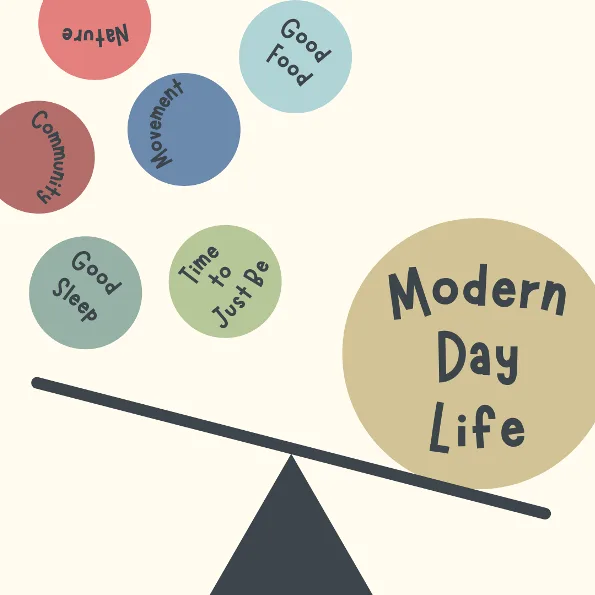
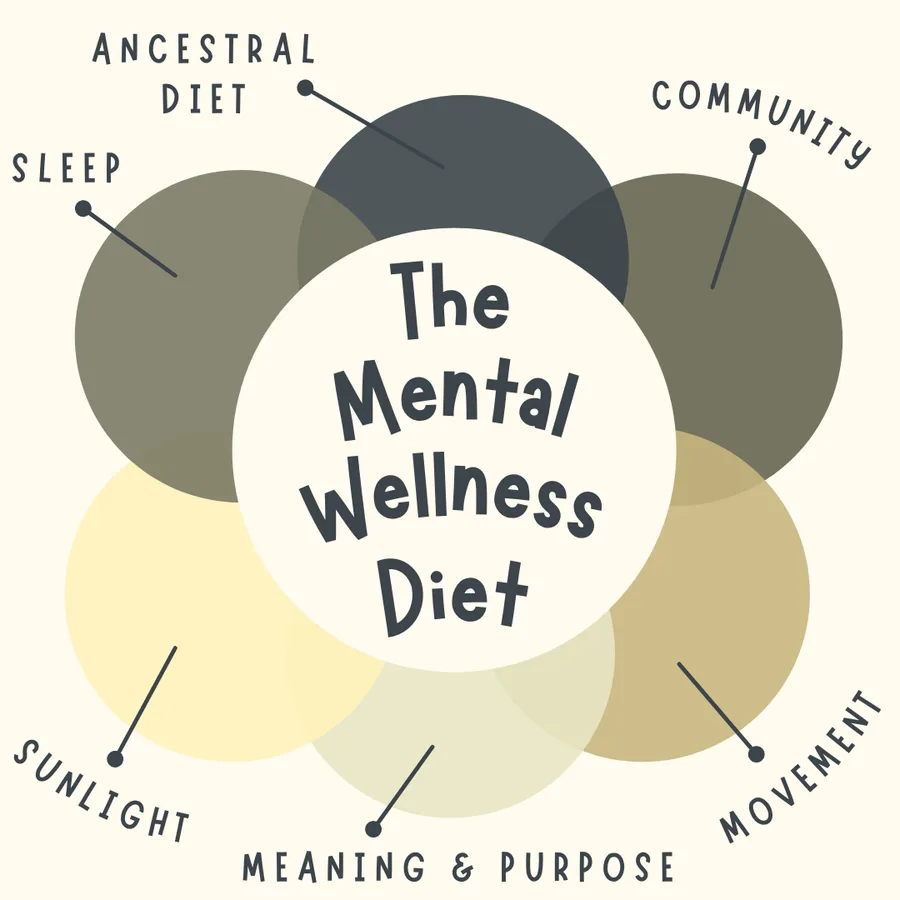
We've drifted. In modern-day life, we've drifted away from the elements of life that lift our spirits and make us whole. We've drifted away from good food, restful sleep, hours of sunlight, constant movement, and the sense of belonging to a tight-knit community.
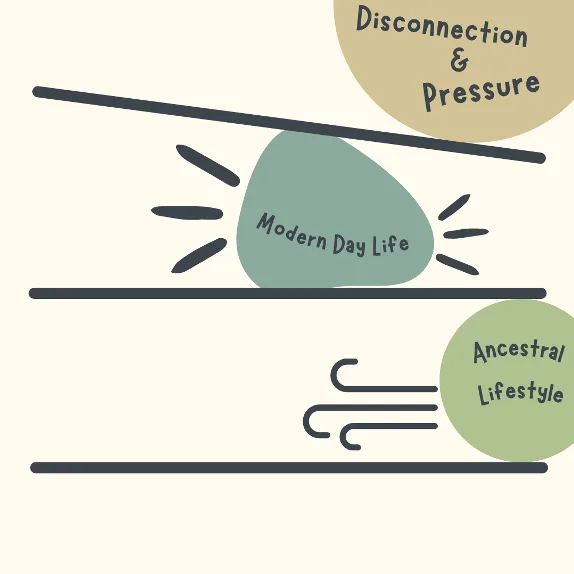
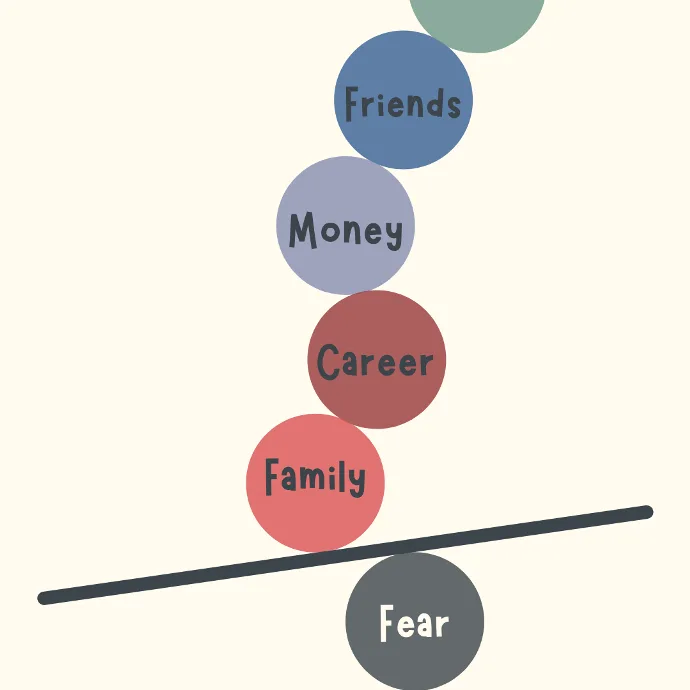
Instead, we've gravitated towards all of our modern conveniences and comforts. Modern-day life is relatively easy. But it's also lonely, disconnected, pressure-filled, and flooded with fears of inadequacy.
Sure, things were not necessarily easier in ancient times. Persistent risk of famine, freezing winters, and a chance of warfare was the typical forecast for our ancestors. These dangers loomed large over daily life.
Yet our ancestors' experience of life was full of those elements of wellness. Their days were filled with more movement, face-to-face socializing, cooperation, and a bit more loafing around during the day. That's how it goes when your one and only purpose is survival.
Simply getting through the day and meeting their basic needs was an accomplishment for our ancestors. Compare that to modern-day life, when "just getting through the day" sounds more like a failure than a victory.
Plus minus
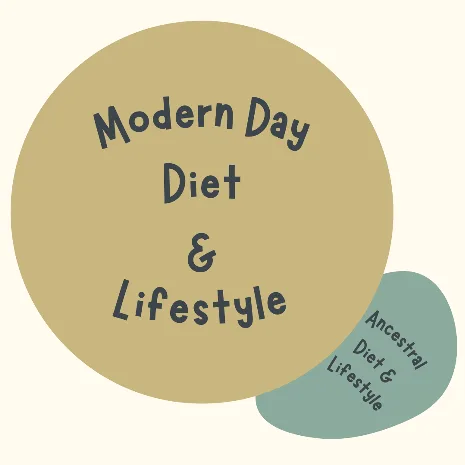
Common sense would say that in order to feel well, we have to put work into re-integrating the ancestral ways of living into our chaotic modern-day lives. That's obviously true for our physical health.
Is the same true for our mental health? Considering the drift, is it any coincidence that today 1 in 5 adults live with a mental illness?
What did we gain or lose relative to our mental and emotional lives over the past millennia?
We gained a chaotic world marked by overstimulating technology, excessive greed, pervasive social competition, and subtle but palpable disconnection between ourselves and the people closest to us in life.
We lost strong and dependable social connections, immersion in nature, a really great diet of wholesome food straight from the Earth, as well as ample opportunity to take the time to sit and reflect.
Problematic solutions
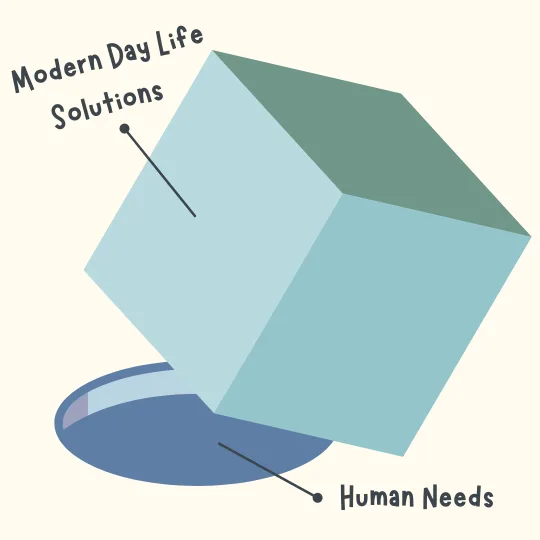
By now, science and technology have come up with answers to almost every inconvenience in our modern-day lives. Yet once the solutions started flowing, we slid into a collective delusion that emotions are dangerous.
There are so many solutions out there for all kinds of frustrations and inconveniences. Why should we feel bad at all? Clearly, someone out there must have invented a solution for that exact problem. Why stop and tune in to our emotions when a speedy solution is just a scroll away? Nowadays the solution is the act of scrolling itself.
The truth is: not all feelings are problems. Avoiding or pushing down and away our feelings is more often the problem.
Now, intense negative emotions can create immense suffering, dysfunction, and loss in our lives. Mental illness symptoms are genuine and debilitating. But not all feelings or negative emotional states are permanent, impairing, or even toxic. Feelings are important.
Negative emotions have been hardwired into us from ancient times. Negative emotions helped to protect us in a dangerous world. Fear kept us safe from dangers.
The pain of social isolation pushed us to cooperate and forgive. The feeling of being overwhelmed pushed us to connect, talk it out, and accept help when necessary.
These negative emotions are still trying to protect us in modern-day life.
Modern-day life tries to offer us a bunch of solutions that immediately, yet temporarily, mute those negative emotions. Modern-day life is designed to get us to exchange our attention and our money for these quick solutions.
The modern-day life prescriptions for depressive symptoms and anxiety include binges on social media, junk food, and trashy reality TV, as well as drugs, sex, alcohol, and other extreme endeavors. They all feel good and kind of work, just not for very long.
Tune in to turn it down
As you've likely gathered, in The Mental Wellness Diet book (TMWD), feelings are considered to be really good sources of information. TMWD puts forth the argument that as we move forward in life, all of our feelings, especially our negative emotions, can help us make better decisions.
Negative emotions are pieces of information that can actually help push us in the right direction.
Depression can feel like something big is lacking. It's lonely and it's usually kept a secret.
Anxiety can feel like multiple fire alarms are going off all over our brain, all at the same time. Clearly, that alone is frightening and disturbing, but later on all that anxiety can bleed into anger. It's disorienting.
Scattered attention can lead us to feel like what's so easily doable for others is nearly impossible for us. It's demoralizing.
Despite the devastating nature of these illnesses, our negative emotions are still great sources of information. Fear and anxiety let us know what we truly care about in life. Depression and sadness highlight for us what we've lost, what we need to grieve, what important pieces of our lives are missing. Even scattered attention can point out for us which parts of our lives we really don't want to look at.
If in response to negative emotional states we try to use one of modern-day life's quick fixes, the result could be minimal relief over the long term. This is because every modern-day life solution begs us to ignore our feelings.
When the solution becomes the focus, who we are and what we need or even want in life fades into the background. This is how we've drifted.
The mash up
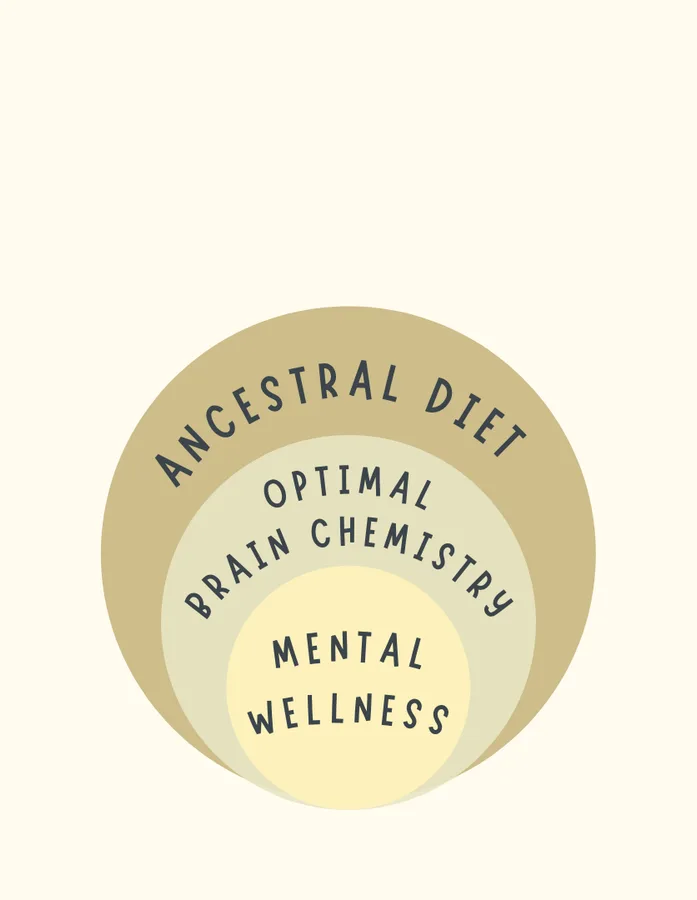
A central theme in TMWD is awareness. It's the idea that we can pick out the major drivers of our mental and emotional health, those that pull us towards illness as well as those that push us towards wellness, by looking back to traditional practices of our ancestors.
The theme of awareness shapes the guidance provided in The Mental Wellness Diet book. TMWD was put together with research from various fields, including mental health research, nutritional science, and even some anthropology. The overarching principles are simple.
We evolved on a certain kind of planet (green landscapes, clean air and water, only unprocessed whole foods, tight-knit tribal communities, etc.), but we now find ourselves in a very different place with new and nearly invisible stressors.
At the same time, the nutrients that helped our brains grow into supercomputers are now generally missing in our typical Western diet. Also at the same time, in modern-day life, we have become conditioned to disconnect from our feelings.
We cannot go back to living as hunters and gatherers. But if we can somehow find ways to reintegrate those positive and healing elements into our lives, we might be able to reclaim control over our mental wellness.
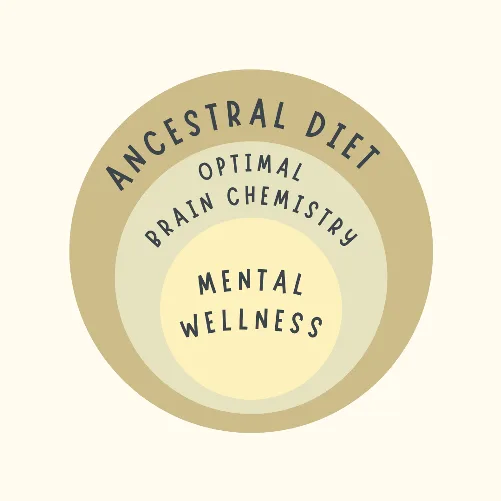
The logic here is that the body and brain need certain nutrients to function optimally. The opposite is also true: our brains function better when some foods are absent (think sugar, trans fats, pesticide residues, and artificial additives).
When our brain is flush with the nutrients it needs for neurotransmitter function, energy production, waste removal, neuronal communication, and balanced immune function, our brains function optimally.
As a result, we feel and perform better. When we're feeling better, we are less likely to seek out highly palatable, nutrient-depleted, toxic fast foods, and all of the other quick fixes modern-day life tries to offer us.
Food equals function
The guidance throughout TMWD is meant to help the reader learn to cope with the most destructive aspects of modern-day life and reconnect with the best parts of our humanity.
TMWD is built on strategies geared towards avoiding the unnecessary and destructive pressures of modern-day life. On the flip side, it details which foods and practices we can adopt into our lives in order to feel and function at our best.
The TMWD philosophy on diet
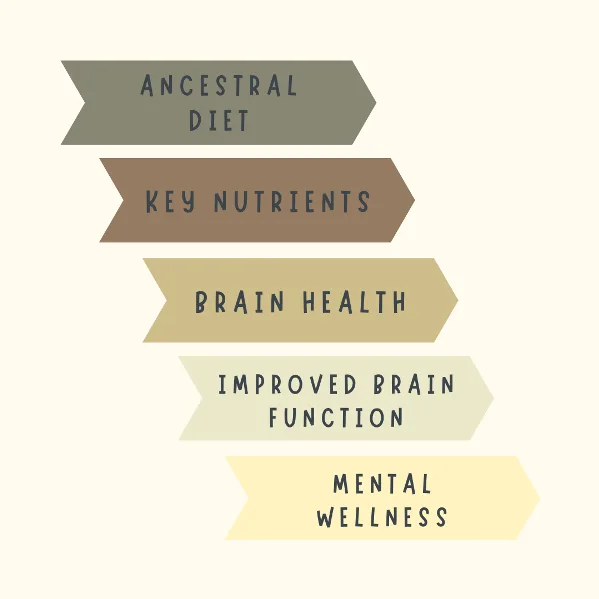
Ancestral foods contain much higher amounts of key nutrients than popular foods in the Western or Standard American diets. These key nutrients, in adequate supply, support critically important structures and functions in our brains. Once our brain is well-fed with these key nutrients, it will function better. Once our brain is functioning at its best, we will be able to feel and function at our best.
Alternatively…
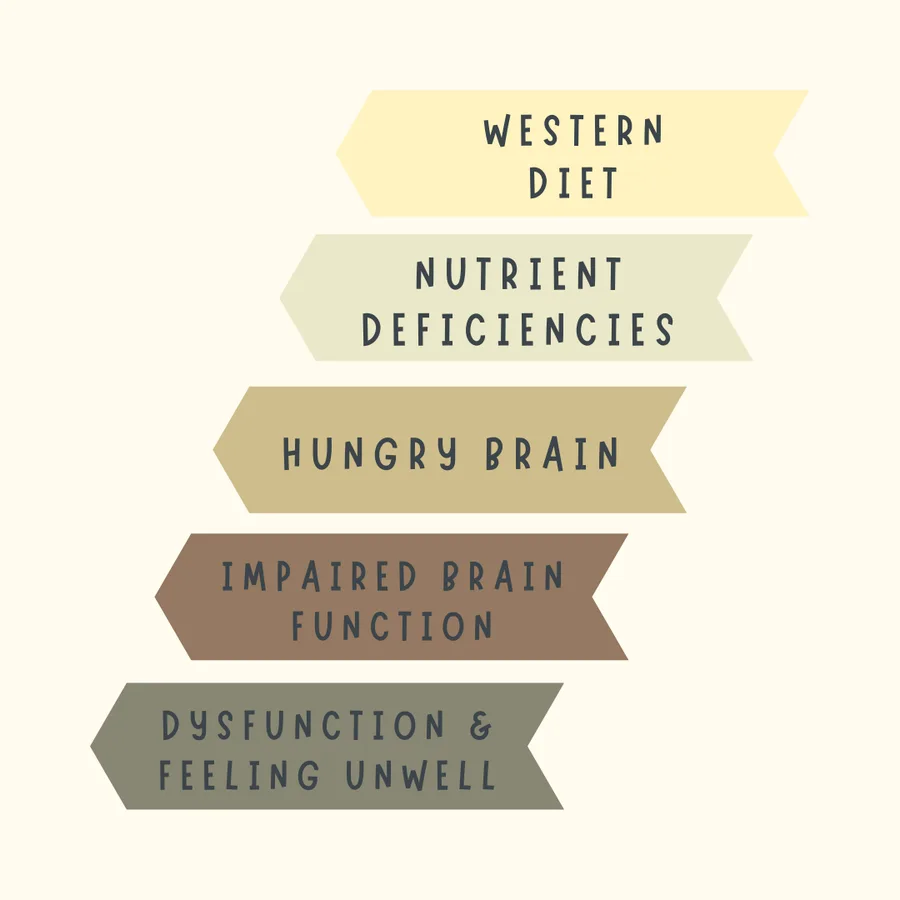
Western, Standard American and other diets generally lack sufficient quantities of the key nutrients our brains need. With inadequate key nutrients, our brain structures and function will suffer. A brain starving for the nutrients it needs will not be able to function optimally. As a result, we will be much more likely to experience dysfunction and possibly greater severity of mental illness symptoms.
So what's for dinner?
Below, we'll focus on food and a few of the key nutrients that our brain craves. For each of the following functions, there is a consistent pattern that unfolds.
There is a set of brain functions that mediate our internal experience of life. Each of these structures and functions is necessary for us to thrive. We need to feel. We need to perceive and understand. We need to filter our thoughts. We need to inhibit or mute emotions to some degree. We need to find balance and calm. We need all of these functions so that we can feel well.
The best way to support each of these functions is to feed the brain the raw materials that support them, and the best way to get enough key nutrients is to focus on the foods that carry the highest amounts of them. For that, we need to eat the way our ancestors did before modern-day life ushered in the diets popular today.
Chapter 1 · Zinc · Steak
Respond
The Respond chapter in TMWD is all about neurotransmitters. Neurotransmitters are molecules our brain uses to respond to life as it is happening around us. Adequate neurotransmitter release (and degradation) helps us to feel what's happening around us in life.
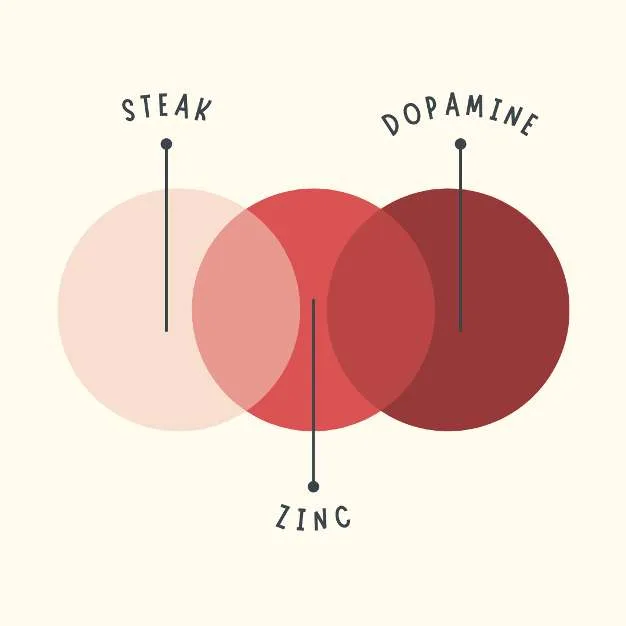
Zinc sensitizes dopamine receptors. Sensitive and functional dopamine receptors make it easier for us to hear the dopamine released in response to things happening around us in life. One of the best sources of zinc is red meat.
Recipe · 1–2 servings
Cast iron skillet steak
Ingredients
- 10 oz New York strip steak
- 2 tbsp EVOO
- Salt to taste
- Pepper to taste
Directions
- Preheat oven to 350°F.
- Leave the steak on the counter at room temperature for 20–30 minutes.
- Pat the steak dry on all sides with paper towels.
- Rub the steak with a dash of salt and a generous amount of pepper.
- Heat the EVOO in a cast iron skillet on medium-high heat.
- Wait until the skillet is hot: right when the oil just starts to smoke, add the steak.
- Sear the steak 3 minutes on each side.
- Take the skillet off the burner and place it in the preheated oven.
- Bake for 8–10 minutes.
- Remove and cover with aluminum foil for 5 minutes.
- Plate the medium-rare steak and serve.
Clean the cast iron skillet while still warm, using just warm water and a stainless-steel scrubbing pad. Do not use dish or other soap. Once clean, dry immediately with a towel, rub a small amount of EVOO over the inside of the skillet and store in a dry place.
Chapter 2 · Choline · Eggs
Build
The Build chapter in TMWD is all about healthy neurons. Healthy, well-built neurons help us to think, perceive, and communicate with clarity.
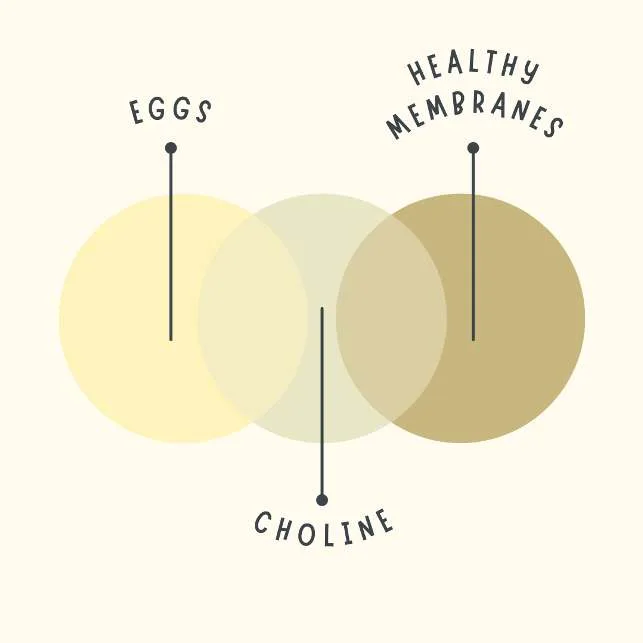
Choline helps build healthy, flexible neuronal membranes, making it easier for us to think and communicate clearly without interruption. One of the best sources of choline is eggs.
Recipe · 4 servings
Frittata
Ingredients
- 1 lb ground beef or pork
- 1 tbsp coconut oil or EVOO
- 1 cup of vegetables: kale, broccoli, cauliflower, onions, peppers, mushrooms, etc.
- 8 whole eggs, whisked
- Onion or garlic powder
- Sea salt and pepper
- Chopped fresh basil, tomato slices or shredded cheese for garnish (optional)
Directions
- Preheat your oven to 350°F.
- Heat the oil over medium heat in a 10" cast iron skillet.
- In a large bowl, whisk your eggs well with onion or garlic powder, salt and pepper, and set aside.
- Add the ground meat to the pan and cook, breaking it up as it cooks so the meat browns evenly.
- Once the meat is almost fully browned, remove it from the skillet and set aside.
- Add the vegetables to the pan and sauté, stirring frequently.
- Once the vegetables are soft, add the browned meat back to the skillet.
- Slowly pour the egg mixture over the meat and vegetables to cover.
- Top with sliced tomatoes or basil if desired.
- Bake in the preheated oven for 20 minutes, or until the eggs are solid throughout.
- In the last two minutes, pull out the skillet and sprinkle cheese over the top, if desired.
- Remove the skillet and let the frittata cool.
- Cut into slices and serve.
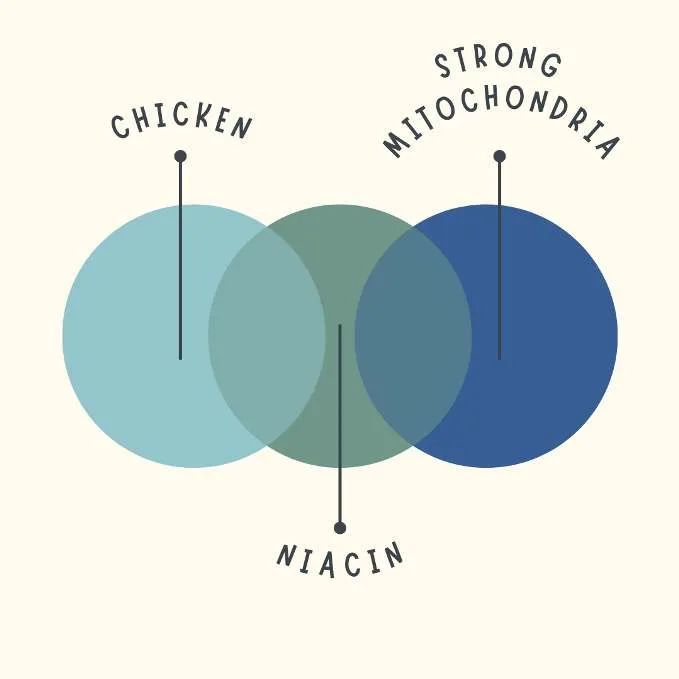
Chapter 3 · Niacin (vitamin B3) · Chicken
Fuel
The Fuel chapter in TMWD is all about the energy supply for our brain. Adequate energy supply offers us the ability to sustain our focus and control our impulses.
Niacin (vitamin B3) helps provide energy to our brain. Specifically, niacin helps to fuel our frontal cortex. A well-fed, functional frontal cortex makes it easier for us to sustain our mental energy, navigate our emotional upwellings, and control our impulses. One of the best sources of niacin is chicken.
Recipe · 4 servings
Cast iron skillet chicken
Ingredients
- 2 skinless chicken breasts
- 1 tbsp EVOO
- Salt and pepper to taste
Directions
- Preheat oven to 425°F.
- Pat the chicken dry with paper towels.
- Heat the EVOO in a cast iron skillet on medium-high heat.
- Wait until the skillet is hot: right when the oil just starts to smoke, add the chicken.
- Sear 2 minutes on each side.
- Remove the skillet from the stovetop and place it in the preheated oven.
- Cook another 10 minutes.
- Remove from the oven, cover with aluminum foil and let rest for 5 minutes.
- Plate and serve.
Clean the cast iron skillet while still warm, using just warm water and a stainless-steel scrubbing pad. Do not use dish or other soap. Once clean, dry immediately with a towel, rub a small amount of EVOO over the inside of the skillet and store in a dry place.
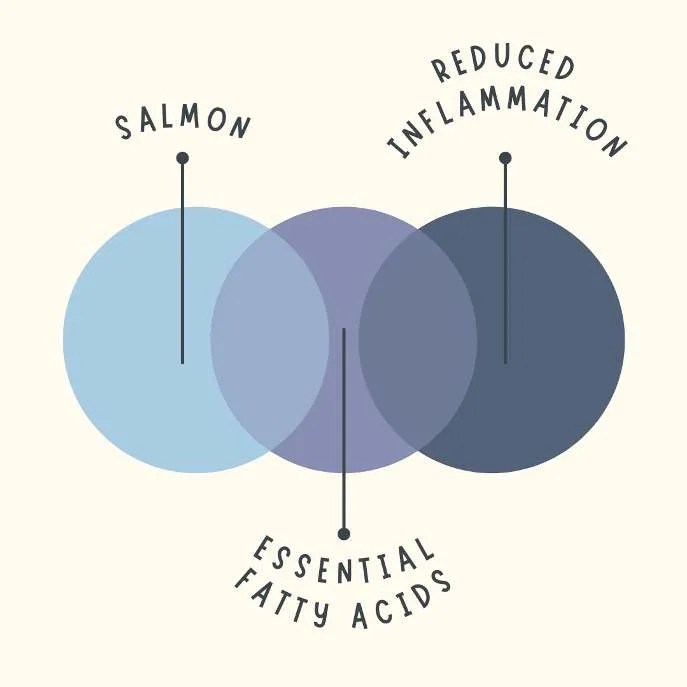
Chapter 4 · Essential fatty acids · Salmon
Protect
The Protect chapter in TMWD is all about limiting the excessive, chronic inflammation that plagues us in modern-day life. A balanced immune system with limited chronic inflammation helps us experience life calm, centered, and composed.
Essential fatty acids tame excessive or chronic inflammation, making it easier for us to feel calm and at peace. One of the best sources of essential fatty acids is salmon.
Recipe · 2 servings
Baked salmon
Ingredients
- 2 salmon fillets
- 1 tbsp EVOO
- 1/2 tsp Italian seasoning or herbes de Provence
- Salt and pepper to taste
Directions
- Preheat oven to 400°F.
- Pat the salmon dry.
- Place the salmon on a baking sheet or in a glass baking dish.
- Toss with EVOO, herbs, salt and pepper.
- Place the salmon in the oven.
- Bake for 10–15 minutes.
- Check on the salmon around minute 8.
- Press down on the salmon with a fork.
- If the salmon flakes or separates along its lines, it's ready.
- Remove and serve with a squeeze of lemon.
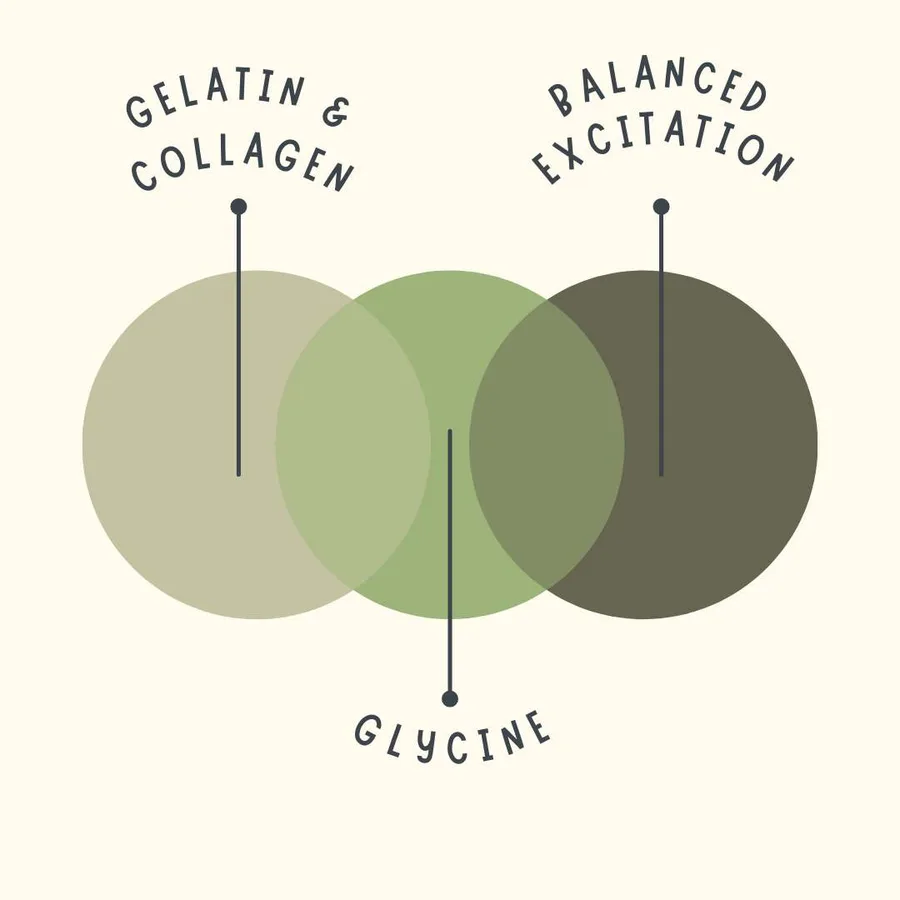
Chapter 5 · Glycine · Gelatin & collagen
Balance
The Balance chapter in TMWD is all about striking a balance between excitation and inhibition in the brain. The right balance between excitation and inhibition helps us to experience life with greater calm and composure. The balance between the two allows us to act according to what we know is right for us instead of based on what we fear at the moment.
Glycine supports the brain's calming, inhibitory side, making it easier to keep excitation in check. Some of the best sources of glycine are collagen peptides and gelatin powders.
Recipe · 4 servings
Tart cherry gummies
Ingredients
- 3 cups organic tart cherry juice
- 1/4 cup raw honey
- 9 tbsp beef gelatin powder
- Vitamin C and magnesium powders, if desired
- Silicone tray (1–2" cubes work best)
Directions
- Pour 2 cups of cherry juice into an unheated saucepan.
- Add the beef gelatin powder and stir immediately.
- Turn the stove to medium-low heat.
- Mix together until no more powder is visible.
- Stir frequently while the mixture warms.
- Look for the mixture to turn velvety smooth and reflective.
- Add the remaining 1 cup of cherry juice and 1/4 cup honey.
- Add vitamin C and/or magnesium powders, if desired.
- Continue to stir over heat until a froth appears on top.
- Once froth appears, remove from heat.
- Scoop off the froth and discard it.
- Pour the remaining liquid into the silicone molds right away.
- Let cool on the counter for 30 minutes.
- Place in the refrigerator for at least 2 hours.
- Store the gummies in the fridge and enjoy over the next week.
To learn more
Hopefully, this brief intro to TMWD will get you started on the path to improved function and a greater sense of peace in life.
Remember: TMWD is about eating to build and fuel a better brain. A well-fed brain will help us feel and function better. The only remaining step is to take care of how we make meaning out of life.
© 2021 Justin Bethoney Integrative Psychiatric Nursing, Inc. This e-book is for informational purposes only. By providing the information contained herein we are not diagnosing, treating, curing, mitigating, or preventing any type of disease or medical condition. Before beginning any type of natural, integrative, or conventional treatment regimen, it is advisable to seek the advice of a licensed healthcare professional.